Operations | Monitoring | ITSM | DevOps | Cloud

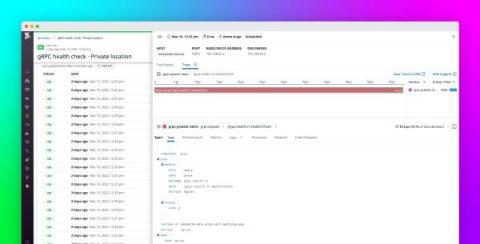
Monitor your gRPC APIs with Datadog Synthetic Monitoring

gRPC is an open source Remote Procedure Call (RPC) framework developed by Google and released in 2016. Although gRPC is still relatively new, large organizations are adopting it in increasing numbers to build APIs to connect complex microservice meshes that use disparate languages and frameworks. gRPC-based APIs can process requests up to seven times faster than REST APIs, and they also allow customers to easily implement SSL authentication, load balancing, and tracing via plug-in libraries.

Synthetics 101 - Part 2: Protecting and growing revenue with proactive monitoring

In part 1 of our synthetics series, we looked at tracking network performance to drive better business outcomes. Here in part 2 of our series, we’ll dig into the very first and most basic business outcome of using digital experience monitoring (DEM). That is, we’ll look at how to protect and grow revenue by proactively monitoring the health, availability and uptime of your critical applications and services, so you can fix issues before your customers’ experience suffers.

Uptime com Transaction Check Basics in less than 3 minutes

Get a lightning fast intro into setting up the Uptime.com Transaction check to monitor your important processes like login forms, contact submissions, and shopping carts. For more in-depth info, check out our detailed video on Transaction Check best practices, and using the Uptime.com Transaction Recorder for an easy, no-code approach to configuring your synthetic monitoring.

Best practices for alerting on Synthetic Monitoring metrics in Grafana Cloud

Ever wonder what your application looks like from the “outside in”? Synthetic monitoring can give you a global overview of your application from your customer’s point of view, observing how systems and applications are performing by simulating the user experience. One tool to help achieve this is the Synthetic Monitoring app, which is a blackbox monitoring solution available in Grafana Cloud. You can use Synthetic Monitoring to monitor your services from all over the world.

Synthetic testing: A definition and how it compares to Real User Monitoring

Performance monitoring is critical for a healthy software application. If you don’t have synthetic testing or real user monitoring in place, opportunities for performance optimizations are slipping through the cracks. With the guidance of a monitoring tool, on the other hand, you could be fixing problems such as slow-loading pages within the hour. The two main types of application monitoring are Real User Monitoring (RUM) and synthetic testing (or synthetic monitoring).

NEW: Splunk Synthetic Monitoring Adds Single Sign-On (SSO) and Security Improvements

Splunk customers are security conscious organizations demanding enterprise-grade features for their global workforce. Today, we are excited to announce several Splunk Synthetic Monitoring updates, including: support for Single Sign-On (SSO) via SAML 2.0, Concealed Global Variables, and an updated synthetic browser version (Chrome 97).