Operations | Monitoring | ITSM | DevOps | Cloud

What's New in InfluxDB 3.8: Linux Service Management, Kubernetes Helm Chart, and Smarter Ask AI

InfluxDB 3.8 is now available for both Core and Enterprise, alongside the 1.6 release of the InfluxDB 3 Explorer UI. This release is focused on operational maturity and making InfluxDB easier to deploy, manage, and run reliably in production. InfluxDB 3 Core remains free and open source under MIT and Apache 2 licenses, optimized for recent data. InfluxDB 3 Enterprise builds on that foundation with long-range querying, clustering, security, and full operational tooling.

AI for IT Operations: How AIOps is Transforming IT Performance & Service Reliability

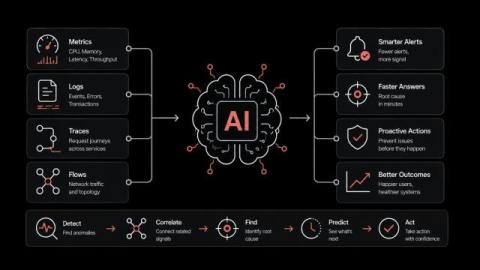
Artificial Intelligence for IT Operations ingests telemetry across logs, traces, events, resource signals, runtime behavior, and application pathways. AI for IT operations reduces alert noise, correlates events into unified narratives, predicts degradation, and drives remediation logic with pattern-based execution. Telemetry growth makes manual triage slow, while inference scales linearly with data.

How To Connect Your Prometheus Server to a Grafana Datasource

Prometheus is one of the most popular open-source monitoring systems in the world. It’s lightweight, easy to deploy, and pairs beautifully with Grafana for dashboards and alerting. If you're running applications or infrastructure on Linux, Prometheus plus one of many Exporters (Redis, NVIDIA GPU, Nginx, etc.) gives you deep visibility into service performance - quickly and reliably.

Building a Code Review system that uses prod data to predict bugs

This post takes a closer look at how Sentry’s AI Code Review actually works. As part of Seer, Sentry’s AI debugger, it uses Sentry context to accurately predict bugs. It runs automatically or on-demand, pointing out issues and suggesting fixes before you ship. We know AI tools can be noisy, so this system focuses on finding real bugs in your actual changes—not spamming you with false positives and unhelpful style tips.

Closing the Year: What 2025 Taught Us About Resilience

By Doreen Jacobi, DERDACK / SIGNL4 It is that time of the year again. Time to reflect and look back at 2025. And I find myself thinking less about platforms and features – and more about the people behind them. The engineers who pick up the phone at 2 a.m. The operators who make judgment calls with incomplete information. The responders who keep systems running when everything feels urgent. If this year taught us anything, it’s this: technology can detect the problem, but people solve it.

Valkey JSON module now available on Aiven for Valkey

The Valkey JSON module implements native JSON data type support within Valkey, allowing users to efficiently store, query, and modify complex, nested JSON data structures directly. This overcomes previous architectural complexities, such as needing to serialize entire documents as strings or flatten data into hashes, by providing native handling for nested data models.

How LinkedIn modernized its massive traffic stack with HAProxy

Connecting nearly a billion professionals is no small feat. It requires an infrastructure that puts the user experience above everything else. At LinkedIn, this principle created a massive engineering challenge: delivering a fast, consistent experience across various use cases, from the social feed to real-time messaging and enterprise tools.

Application Monitoring 101: Queue Time Can Alert Before a Breakdown

Regular monitoring practices can emphasize application response time, but queue time is also often an early and important warning sign. If it rises, you’ll quickly see downstream effects: tail latency, timeouts, and error spikes. This means that this metric can give you a head start tackling app issues before they become user problems. In this post, we’ll discuss queue time, how things can go off track, and practical steps to turn it around.

Scaling Kubernetes GitOps with Fleet: Experiment Results and Lessons Learnt

Fleet, Rancher’s built-in GitOps engine, is designed to scale up to thousands of clusters. However, “how far” can it scale in a real world scenario, you might ask? Earlier this year, we wrote about the Fleet benchmark tool and we made a few discoveries that were very instructive, especially concerning resource consumption and its impact on deployments’ performances.