Operations | Monitoring | ITSM | DevOps | Cloud

IBM LinuxONE and Sysdig: Building cyber resilient systems in hybrid cloud environments

On September 13, 2022, IBM announced the latest IBM LinuxONE Emperor 4, a highly secured and sustainable Linux-based enterprise server designed for companies of all sizes. Sysdig with IBM LinuxONE provides unified visibility across workloads and cloud infrastructure through a single cloud-native monitoring and security platform.


Part 2: Monitoring - Level 1

The first level of the Observability Maturity Model, Monitoring, is not new to IT. But as reliable IT system operation becomes more and more critical, the importance of monitoring continues to increase. A monitor tracks a specific parameter of an individual component in the system to make sure it stays within an acceptable range; if the value moves out of the range, the monitor triggers an action, such as an alert, state change or warning.

Explaining Performance to Non-Technical Stakeholders

Whether you’re an e-commerce company, a SaaS provider, or a content publisher, understanding the performance of your website is important to everyone on the team—not just the developers. Performance is a huge part of the user experience and directly tied to how well your website achieves its goals. But web performance is often measured in very technical terms, like Largest Contentful Paint, that cause most business folk’s eyes to glaze over.

Securing the DX NetOps Development Lifecycle with DevSecOps

Recent, high-profile cybersecurity exploits, such as Sun Burst and Log4j, demonstrate that every enterprise is only a stone’s throw from a software vulnerability. This becomes especially critical when security is breached in a network monitoring component that has privileged access to core enterprise systems. In the case of Sun Burst, a well-known monitoring software provider made international headlines.

Database Decision-Making for Observability, from Simple to Complex

A goal of open-source observability is unifying several different signals to provide the observability everyone wants. It’s always interesting to speak to people on this journey, and how they try to provide it through open-source projects, and the challenges they can face. I was thrilled to host Pranay Prateek on the most recent episode of the OpenObservability Talks podcast.

Distributed Tracing Observability in Microservices

Have you ever tried to find a bug in a multi-layered architecture? Although this might sound like a simple enough task, it can quickly become a nightmare if the system doesn’t have proper monitoring. And the more distributed your system is, the more complex it becomes to analyze the root cause of a problem. That’s precisely why observability is key in distributed systems. Observability can be thought of as the advanced version of application monitoring.

How to download files from ASP.NET Core MVC

I have been implementing a couple of features lately that allow users to download files. During this process, I have visited various namespaces and possibilities with ASP.NET Core. In an attempt not to forget what I have learned and in the hope that this knowledge can be used by others, here is a blog post about downloading files from ASP.NET Core 😊 This post will use an ASP.NET Core MVC application as an example since that is what I am using.

Improve your application monitoring by reducing overhead of managing and updating alert rules

Just about every organization today relies on key applications running on complex multi-cloud environments to transact business and enable users to work. It is critical to ensure that those applications are running optimally. A solid monitoring and alerting system is required to know when an issue needs attention. But having a robust monitoring system is not enough.

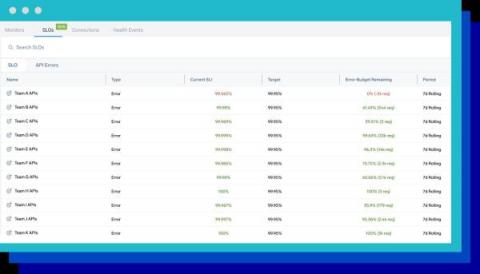
How to get maximum value from Service Level Objectives (SLOs)

A reliable digital customer experience is critical to the success of digital-first businesses. Each minute of downtime can result in the loss of revenue, unsatisfied customers, and damage to reputation. However, as your uptime gets closer to 100%, it gets exponentially harder to improve and often comes at the cost of speed of innovation. A good balance between innovation (i.e., new feature releases) and maintaining an acceptable level of reliability is key to success in the digital world.