Operations | Monitoring | ITSM | DevOps | Cloud

Step-by-step Guide to Monitor Riak Using Telegraf and MetricFire

Monitoring your databases is essential for maintaining performance, reliability, security, and compliance of your infrastructure. It allows you to stay ahead of potential issues, optimize resource utilization, and ensure a smooth and efficient operation of your database system. Effective monitoring of Riak involves collecting, analyzing, and acting on a variety of metrics and logs.

Is Waiting for the Thaw Unbear-able?

It’s not new news that organizations are producing more data than ever. But, in order to take advantage of this data, it needs to be collected, stored, retained, and then, at some point, analyzed. Most analysis tools also act as the retention point for this data. While this may (at first) appear to be the best option for performance, it quickly creates significant problems. First, those systems were never designed for the scale of today’s growing volume of data, currently at a 28% CAGR.

In Their Own Words: Three Ways NetOps Delivers Value to Customers

Now more than ever, modern networks play a pivotal role in today’s business operations. However, this increased importance comes with a challenge: Modern networks are becoming increasingly complex and heterogeneous. Network managers need to ensure optimal performance across various domains—from the data center to multi-cloud and software-defined networks. This requires the consolidation of vast amounts of data from across multi-vendor networks, including environments managed by third parties.

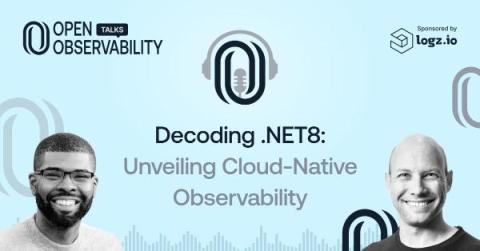
Decoding .NET8: Unveiling Cloud-Native Observability

The.NET programming language is taking cloud native deployment and observability seriously, and most notably with the recent announcement of.NET Aspire stack unveiled at the recent.NET Conf 2023. In the latest episode of OpenObservability Talks, we reviewed the journey to making.NET a “by default, out of the box observable platform,” as ASP.NET Core creator David Fowler put it.

Demystifying Java Lambda Expressions

SRE and IT Operations play a critical role in ensuring reliable, high-performance applications. Yet, SREs (Site Reliability Engineers) often face ‘thrown-over-the-wall’ code deployments to operate without having insights into the code-level features. In my previous article (“Is your Java Observability tool Lambda Expressions aware?”), I delved into one such code-level feature: Java lambda expressions which replace anonymous inner classes.

How to detect and overcome Kubernetes CPU Throttling

A few days ago, I challenged myself: Could I create a CPU throttling monitor without using StackState's docs page? I'll go a bit deeper into CPU throttling later, but first: Why this mission? At StackState, we believe that every software developer should be able to observe the health and reliability of their own application — quickly and easily.

The Top Five Benefits and Challenges of Hybrid Cloud

In recent years, hybrid cloud environments have emerged as a popular, if not de facto, choice for many organizations seeking flexibility, scalability, and security in their IT infrastructure. Industry research firm Mordor Intelligence pegs hybrid cloud as a nearly $130bn market in 2024, growing at a better than 22% clip over the next five years.

What's New in Sysdig - February 2024

Hey there! I’m Devin Limo, a Senior Customer Solutions Architect here at Sysdig. February was a whirlwind, and we’ve got some awesome updates you don’t want to miss. From deep dives into critical vulnerabilities to game-changing product updates, we’ve got you covered. Hot off the press: Falco has graduated within the Cloud Native Computing Foundation (CNCF)!

Upgrade to SCOM 2022: Choosing between in-place upgrade and side-by-side installation

Upgrade to SCOM 2022: Choosing between in-place upgrade and side-by-side installation With mainstream support for SCOM 2019 ending on the 9th of April 2024, it is time to start planning for the upgrade to SCOM 2022. However, there are several factors to consider before making an upgrade. One of them is whether you should choose an in-place upgrade or a side-by-side installation. In this blog post, we aim to give you some important aspects to evaluate when making your decision.

Tap Into Fully Integrated Hybrid Cloud Monitoring for Faster Resolution

Late last year we announced ScienceLogic’s Hollywood release, aimed at accelerating AIOps adoption through its human-friendly platform. By integrating generative AI insights with observability and automation, we took a big step forward in simplifying the work of IT teams. A key component of this goal was upgrading SL1’s features, specifically our now fully integrated hybrid cloud monitoring for faster troubleshooting.