Operations | Monitoring | ITSM | DevOps | Cloud

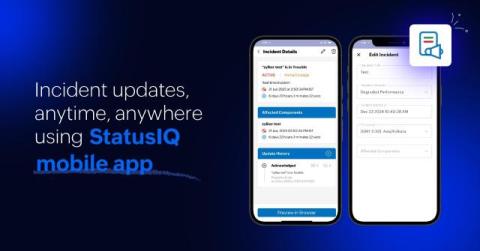
Why a mobile app is the key to better incident communication

While downtime is inevitable, communication should remain swift and transparent. Businesses need a way to relay updates as incidents unfold, ensuring customers, internal teams, and stakeholders stay informed in real time. Relying on emails and web-based updates alone is no longer enough. A mobile-first approach is the solution.

Top reasons why businesses lose trust after acquisition and how you can be smart

Did you wake up to the news that your favorite tool was acquired? You probably got used to the tool's intuitive interface, cost-effectiveness, and feature set, which aligned perfectly with your day-to-day requirements. Your disappointment doesn't end here. It's just the beginning of a series of potential negative consequences of acquisitions.

Improve developer experience and collaboration with Software Catalog

As software ecosystems grow more complex and fragmented, organizations are finding it harder to manage the thousands of interdependencies that make up their environments. For starters, engineers are collectively struggling to uphold security and reliability standards throughout their organizations because they lack a shared view of these complex software landscapes.

The Role of ServiceOps in Enhancing IT Service Delivery and Efficiency

Providing quick and effective IT services is paramount for organizational achievement in dynamic business operations. Technology development creates new obstacles for IT teams that must sustain service excellence and operational effectiveness standards. Recently developed ServiceOps implements a transformation of IT service management (ITSM) that surpasses all organizational needs.

Introducing Learning journeys: New step-by-step guides to get started with Grafana

Our Big Tent philosophy provides the foundation for our broad, modular, and flexible observability platform. With Grafana’s powerful ability to integrate with a wide range of data sources, tools, and plugins, you can create customized solutions tailored to your unique needs.

Native AWS Integrations with AutoDiscovery

For developers, the main quest is building and scaling their applications—not struggling with complex monitoring setups. Yet, observability in cloud-native environments is essential, and configuring monitoring for AWS services has traditionally been a complex and manual process. Developers had to set up Firehose streams, CloudWatch metric streams, and log subscriptions, all while ensuring continuous maintenance for new instances, turning observability into an unwelcome side quest.

High Cardinality Explained: The Basics Without the Jargon

Cardinality refers to the number of unique values in a dataset column. A column with many distinct values—like a user ID or timestamp—has high cardinality, while a column with limited distinct values—like a boolean flag (true/false) or a category with a few possible options—has low cardinality. For example, consider a database of an e-commerce platform.

Log Retention: Policies, Best Practices & Tools (With Examples)

Logs are the backbone of debugging, security, compliance, and performance monitoring. But if you don’t manage retention properly, you’ll either drown in unnecessary data or lose critical insights too soon. Log retention is all about striking a balance between keeping what’s necessary and discarding what’s not.

Understanding Syslog Formats: A Quick and Easy Guide

Syslog is the backbone of logging in many Linux and Unix-based systems, playing a crucial role in monitoring, debugging, and auditing. But not all syslog messages are created equal. Depending on your system, software, and logging configuration, syslog messages may follow different formats. This guide walks you through the different syslog formats, why they matter, and how to work with them effectively.

What is agentic AIOps, and why is it crucial for modern IT?

Every minute of system downtime costs enterprises a minimum of $5,000. With IT infrastructure growing more complex by the day, companies are put at risk of even greater losses. Adding insult to injury, traditional operations tools are woefully out of date. They can’t predict failures fast enough. They can’t scale with growing infrastructure.