Operations | Monitoring | ITSM | DevOps | Cloud

Observability vs APM: What's the Real Difference?

Remember when monitoring your apps meant checking if they were up or down? Yeah, those days are long gone. As systems have gotten more complex—microservices talking to other microservices, containers spinning up and down, serverless functions doing their thing—the approach to understanding system health has had to level up too. APM tools have been the bread and butter for DevOps teams for years, but now everyone's talking about observability.
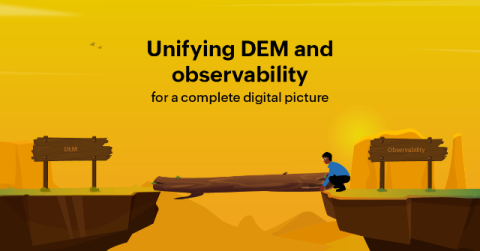
Cross-domain integration: Combining DEM and observability

Effective monitoring and optimization of an interdependent environment require a coordinated strategy. Through the integration of observability and digital experience monitoring (DEM) platforms, businesses can dismantle silos and obtain a real-time, comprehensive view of their whole digital infrastructure. This comprehensive strategy empowers enterprises to proactively handle problems and optimize the end-to-end digital experience, which also improves performance and risk management.

How SpotOn overhauled its observability strategy with standardized tagging and Grafana Cloud

Many engineers would agree: migrating to a new observability platform can be a serious undertaking. But it’s also the perfect opportunity to step back, revisit some of the foundational practices that drive your observability strategy — and reap some major benefits, as a result. This was the case at SpotOn, a provider of restaurant point of sales systems and business software, which recently migrated from four disparate observability tools and consolidated on Grafana Cloud.

The importance of proactive event handling in modern IT observability

Events are the heartbeat of modern IT observability. Events are the threads that wave across distributed IT systems to create a fabric of cohesion. They empower teams to shift from reactive firefighting to proactive management, fostering resilience, actionable insights, and superior user experiences (UXs) with platforms like ManageEngine Site24x7. This blog explores the pivotal role of events in observability and how to harness them effectively.

Honeycomb Acquires Grit: A Strategic Investment in Pragmatic AI and Customer Value

We’re excited to share that Honeycomb has completed our first-ever acquisition: we’re joining forces with Grit, bringing on board not only a strong team, but also compelling technology that supercharges our ability to deliver on our mission: to bring observability to every software engineer. This is a strategic move that will help us deepen the value we deliver to customers and accelerate our vision for what modern observability can and should be.

Comparing ELK, Grafana, and Prometheus for Observability

Monitoring and observability are cornerstones of modern infrastructure management. Three popular solutions that often come up in this space are the ELK Stack, Grafana, and Prometheus. This comparison breaks down the key differences, use cases, and integration capabilities to help you determine which tool or combination better suits your operational needs.

Calico Open Source 3.30: Exploring the Goldmane API for custom Kubernetes Network Observability

Kubernetes is built on the foundation of APIs and abstraction, and Calico leverages its extensibility to deliver network security and observability in both its commercial and open source versions. APIs are the special sauce that help automate and operationalize your Kubernetes platforms as part of a CI/CD pipeline and other GitOps workflows. Calico OSS 3.30, introduces numerous battle-tested observability and security tools from our commercial editions. This includes the following key features.

Observability: It's Every Engineer's Job, Not Just Ops' Problem

For years, organizations have used the term “observability” as an evolution of monitoring, a discipline practiced by operations teams to understand whether production software was working. I’ve been annoyed by this—not because it’s philosophically wrong, but because it diminishes the importance of observability as a generalized software engineering practice.

The Critical Role of Observability in Healthcare IT

Healthcare organizations are increasingly leading the charge in technology adoption, rapidly deploying advanced applications and digital tools to improve patient outcomes and operational efficiency. However, this acceleration is placing unprecedented pressure on existing IT infrastructure. Teams are being asked to support next-generation workloads, such as AI-powered diagnostics and real-time data platforms, on legacy systems, often without the benefit of increased budget or headcount.