Since June 2020, when we launched the new Monitive, we have the same monitoring network of 8 locations. It’s time to expand. The current locations are VPS servers from DigitalOcean and Linode. I like to mix it a bit, so that we don’t rely on a single provider, but not too much, since the administrative overhead of managing dozens of providers is another lesson learned in 10 years of uptime monitoring.
Do you know who interacts with whom, when, and for how long and how frequently in your network? Network administrators must have clear visibility of bandwidth utilization using a robust bandwidth monitoring tool, to find out slow loading yet crucial connections, to plan out the capacity of network properly or to control the Quality of Service.
Regardless of the tech stack used, many developers have already used Redis or, at least, heard of it. Redis is specifically known for providing distributed caching mechanisms for cluster-based applications. While this is true, it’s not its only purpose. Redis is a powerful and versatile in-memory database. Powerful because it is incredibly super fast. Versatile because it can handle caching, database-like features, session management, real-time analytics, event streaming, etc.
Before we start, please take a moment to appreciate what day it is. IoT, or Internet of Things, has been a buzzword for longer than usual. Buzzwords usually have two common properties, and then their paths fork. I like thinking about buzzwords and about the useful aspects of what they mean. The most recent public example focuses on another buzzword currently in its hype phase: observability.
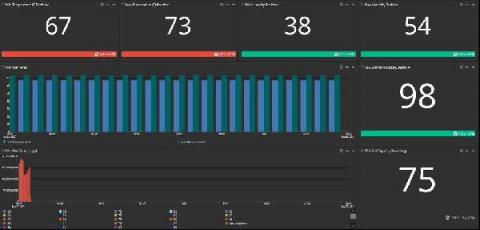
LogicMonitor dashboards are truly customizable — customizable enough to allow users to visualize virtually anything. Dashboards provide our users with a wide array of capabilities, from capacity planning and service availability notifications to root cause analysis and IT spend forecasting capabilities. We’ve seen LogicMonitor users get radically innovative when it comes to creating unique dashboards that add value to their lives both in and outside of work.
CVE-2020-13942 is a critical vulnerability that affects the Apache open source application Unomi, and allows a remote attacker to execute arbitrary code. In the versions prior to 1.5.1, Apache Unomi allowed remote attackers to send malicious requests with MVEL and OGNL expressions that could contain arbitrary code, resulting in Remote Code Execution (RCE) with the privileges of the Unomi application.
I’ve got some exciting news! With the recent release of Puppet Comply 1.0.2, we’re providing the ability to assess Windows 2016 servers against DISA STIGs, required security standards for companies that do business with the U.S. Department of Defense. This new capability makes it drastically easier for organizations to assess and demonstrate compliance with DISA STIGs.
Microsoft recently announced a campaign by a sophisticated nation-state threat actor, operating from China, to exploit a collection of 0-day vulnerabilities in Microsoft Exchange and exfiltrate customer data. They’re calling the previously unknown hacking gang Hafnium. Microsoft has apparently been aware of Hafnium for a while — they do describe the group’s historical targets.
Datadog was founded in 2010 by Olivier Pomel and Alexis Le-Quoc. They develop the Datadog to reduce the friction they experienced between system administration teams and developers. Together they raised over $648 million to bring its valuation to $7.8 billion by the end of 2019. Let’s dig deep into Datadog to know its competitors.