Operations | Monitoring | ITSM | DevOps | Cloud

The latest News and Information on DevOps, CI/CD, Automation and related technologies.

NHS and healthcare data on UK Sovereign Cloud: A compliance primer

Healthcare data sits at the top of the sensitivity hierarchy. Patient records are personal data under UK GDPR. Medical records are separately regulated under sector-specific frameworks. Clinical research data may be subject to research-specific rules. Genomics data carries residency implications that go beyond standard personal data protections. NHS data specifically is governed by frameworks that add UK public sector expectations on top of the healthcare-specific ones.

Monitoring Oracle ASM with Custom Metrics | The Tony and Tonie Show Ep 49

Even small Oracle ASM issues can become big database problems. Here's how to spot the warning signs early. Tony and Tonie discuss how Redgate Monitor custom metrics help teams close a common monitoring gap: surfacing Oracle ASM health and performance issues before storage pressure, rebalancing problems, or disk group failures become database incidents.

Bringing Third-Party Apps into Harness AI Chat: Our MCP Gateway for Distributed Enterprise Systems | Harness Blog

TLDR: When you work in Harness AI Chat, your work doesn't stop at Harness. Your pipelines live here, but the change you actually need to make might be a YAML file in GitHub, a Jira ticket, or a Confluence doc. So we built an MCP Gateway inside Harness that lets AI Chat reach those third-party apps for you: safely, under Harness's own access controls and secrets, and without dropped sessions across our distributed fleet. This is the story of what we built and why.

Your FY27 plan deserves a real AI number, not a hedge

Budget season is starting and most finance teams are finding the AI line is the most evasive line on the page. You lived through the year. AI spend came in higher than planned and moved in ways nobody could foresee or forecast. And when the board asked what it produced, the honest answer probably was “we’re working on it.”

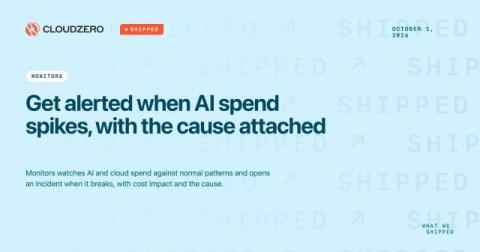
Shipped: Codex spend tied to the work behind it

People run Codex on their own laptops. When Codex is signed in with a ChatGPT subscription, OpenAI’s own admin console shows who used it and how much: messages and credits. What it doesn’t show is what any of that usage was for, or how it compares to what your team spent on other AI tools. The CloudZero desktop agent for macOS installs on a Mac, sees the traffic from AI coding tools, and prices what those tools use.

Why is AI so expensive? The real cost drivers of AI

AI is expensive because the model bill is only part of the cost. Three components set the floor: model subscriptions, per-token API pricing, and infrastructure. Three more make it move: adapting models to your business, catching and fixing errors, and rising energy and datacenter costs. Efficiency doesn't fix it, because cheaper AI gets used more, not less. Businesses are willing to spend on AI. Research from Deloitte found that in 2025, 85% of organizations increased their AI investments.

KPI cards: build a reliability dashboard that doesn't force tradeoffs

This week's Feature Friday: Principal Product Manager Christine Byun walks through KPI cards, a new way to build custom dashboards in Engineering Intelligence. KPI cards pull key metrics, like change failure rate and rollback frequency, into compact tiles so they stay visible without taking up chart space. That means the metric you're actively working, incidents, in this demo, gets full-size room, without losing sight of the rest of your system.

Kepler and Insights: Built From Opposite Directions

Most companies buy AI tools for developers and hope the impact shows up somewhere. A faster sprint. Fewer escaped bugs. Something. What they don’t have is a way to actually see it happening, which means adoption becomes a leap of faith instead of a measured bet. That’s the gap Kepler and GitKraken Insights close together, and it’s worth understanding as one story, not two separate product updates.

Synthetic Monitoring Is Broken. Your Production Traffic Can Fix It.

Synthetic monitoring has been a critical part of application reliability for years. It gives engineering and operations teams a way to proactively test applications, APIs, and critical customer journeys before users encounter problems. But there is a fundamental limitation with the traditional approach: Someone has to create the tests. As applications become more distributed and customer journeys become more complex, organizations can end up maintaining hundreds or even thousands of synthetic scripts.