Operations | Monitoring | ITSM | DevOps | Cloud

The latest News and Information on DevOps, CI/CD, Automation and related technologies.

A Look at the Top 7 IT Automations for Highly Effective Organizations

More than three decades have passed since Stephen R. Covey made the world highly effective. His 1989 bestseller, The 7 Habits of Highly Effective People, inspired just about everyone. How could anyone pass up the chance to become highly effective by adopting just seven new habits!?

Cloud-Based vs Cloud-Native: What's the difference?

Get to know the differences between cloud-native and cloud-based applications, their benefits, and why a cloud-native tool like Cloudsmith is a game-changer for efficient and secure software artifact management. The term 'cloud' has become a buzzword in the tech industry, often used interchangeably to describe anything from online storage to complex computing services. But what does it really mean? And more importantly, what does it mean for your business?

Non-trivial: What you should do when developers say this

Non-trivial: What you should do when software developers say this. Spoiler alert: all they really mean is they need time to investigate what's going on. Here's part 4 of 4 of Sleuth's CTO and cofounder, Don Brown's take on decoding developer speak. Give Sleuth a try and see how we empower software teams to build faster by making engineering efficiency easy to improve and measurable — in a way that both managers and developers love.

We used GPT-4 during a hackathon-here's what we learned

We recently ran our first hackathon in quite some time. Over two days, our team collaborated in groups on various topics. By the end of it, we had 12 demos to share with the rest of the team. These ranged from improvements in debugging HTTP request responses to the delightful “automatic swag sharer.” Within our groups, a number of us tried integrating with OpenAI’s GPT to see what smarts we could bring to our product.

Using An Infrastructure Monitoring Dashboard

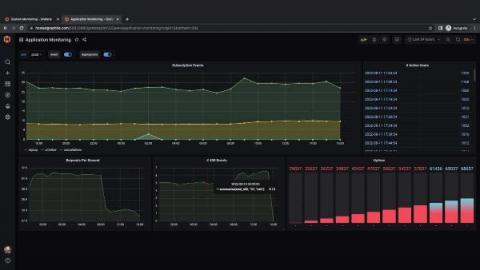
As businesses embrace more cloud-native technologies and IT infrastructure becomes more dispersed, they must connect their business goals and end-user experience with the availability and performance of their IT infrastructure. This change necessitates infrastructure monitoring to assure compatibility with cloud environments, operating systems, storage, servers, virtualized systems, and other components.

Why and how to use Rust on Ubuntu

Rust has been the language most loved by developers for the last 8 years and it is seeing increased adoption by software companies of all sizes. However, its many high-level rules and abstractions create a steep initial learning curve which can leave the impression that Rust is the preserve of a select few but this couldn’t be any further from the truth. Let’s examine why Rust is often a great choice and take a look at how to get started with it on Ubuntu.

Webinar: Embracing Declarative Provisioning and Observability in cloud environments

Organizations face increasingly complex challenges in deploying and managing their systems in today's rapidly evolving technological landscape. Declarative provisioning and observability have emerged as a powerful approach to address these challenges. This talk delves into declarative provisioning and observability, exploring its benefits, principles, and practical implementation strategies.

Seamlessly Minimize Unnecessary Data Fetching with GraphQL Queries

Many processes in our daily software development chain require data analysis in real-time. Ensuring the reliability of the data is vital, since multiple processes may rely on it. While taking into account the performance and fetching only the relevant data that is required for our specific use case.

Top 3 public cloud costs to watch

“We moved to the cloud and now everything is more expensive!” Unfortunately, this is a common utterance from companies that have made the leap to a public cloud-based architecture, and a slowdown in adoption growth seen during the pandemic is hitting providers big and small as organisations rationalise cloud spend in the face of rising costs. The good news is these costs can typically be reined in without too much disruption or the need to retreat from the cloud.