Operations | Monitoring | ITSM | DevOps | Cloud

OpenMetrics vs OpenTelemetry - A guide on understanding these two specifications

OpenMetrics and OpenTelemetry are popular standards for instrumenting cloud-native applications. Both projects are part of the Cloud Native Computing Foundation (CNCF) and aim to simplify how we generate, collect and monitor services in a modern cloud-native distributed application environment. Let's have a look at how both the standards are aiming to help solve the observability conundrum.

Monitor Kubernetes Hosts with OpenTelemetry

It’s 3 AM. API latency just spiked from 200ms to 2s. Alerts are firing, and users are frustrated. You SSH into the first server: top, free -h, iostat — nothing unusual. On to the next host. And the next. That’s how most of us learned to debug. The tools worked, and we got good at using them. But as infrastructure became distributed and dynamic, this approach started to break down. Modern monitoring needs more than SSH and top. It needs unified telemetry.

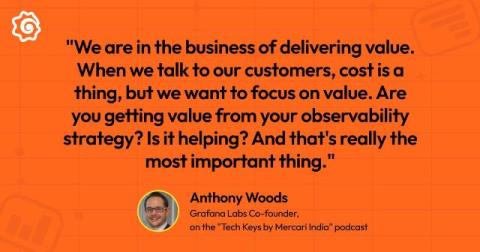
Grafana Labs Co-founder Woods: Market maturity, OpenTelemetry, and AI are reshaping observability

As organizations navigate increasingly complex tech environments, unified observability practices have become essential. That was one of the main takeaways from Grafana Labs Co-founder Anthony Woods’ recent appearance on “Tech Keys by by Mercari India,” a podcast hosted by Vaibhav Khurana, Head of Platform Engineering at Mercari India.

LLM Observability in the Wild - Why OpenTelemetry should be the Standard

A few days ago I hosted a live conversation with Pranav, co-founder of Chatwoot, about issues his team was running into with LLM observability. The short version: building, debugging, and improving AI agents in production gets messy fast. There's multiple competing standards for default libraries for LLM observability. And many such libraries like OpenInference which claim to be based on OpenTelemetry don't strictly adhere to it's conventions.

An overview of Context Propagation in OpenTelemetry

To effectively manage modern applications, you need to understand how they work on the inside. Distributed tracing is the key to this, providing a detailed picture of a request's journey across every service. OpenTelemetry has emerged as the industry-standard framework for implementing tracing and achieving true observability in complex, distributed systems. In this article, we embark on a journey to explore the core concept of context propagation within Open Telemetry.

Monitor and optimize your systems with Uptrace

Uptrace is your single source of truth for monitoring, understanding, and optimizing complex distributed systems. Proven in production for over five years and trusted by more than a thousand installations worldwide, it lets you see your system like never before. What makes the difference is that Uptrace is pure OpenTelemetry, built natively from day one. This isn't a translation layer—it's a direct connection that eliminates friction and ensures zero vendor lock-in. Your homepage serves as your command center, providing complete visibility across your stack at a glance.

OpenTelemetry and Jaeger | Key Features & Differences [2025]

OpenTelemetry is a broader, vendor-neutral framework for generating and collecting telemetry data (logs, metrics, traces), offering flexible backend integration. Jaeger, on the other hand, is focused on distributed tracing in microservices. Earlier Jaeger had its own SDKs based on OpenTracing APIs for instrumenting applications, but now Jaeger recommends using OpenTelemetry instrumentation and SDKs. Warning The original Jaeger client SDKs (based on OpenTracing) are archived and no longer maintained.

OpenTelemetry Exporters - Types and Configuration Steps

In this post, we will talk about OpenTelemetry exporters. OpenTelemetry exporters help in exporting the telemetry data collected by OpenTelemetry. OpenTelemetry frees you from any kind of vendor lock-in by letting you export the collected telemetry data to any backend of your choice. In modern distributed systems, efficiently collecting, transmitting, and analyzing telemetry data from diverse sources poses a significant challenge.

Integrating JMX and OpenTelemetry

The OpenTelemetry community and the contributors to the Java Special Interest Group (SIG) have spent a great deal of time integrating core Java technologies into the project. An integration that is particularly useful is Java Management Extensions (JMX). It has been around since J2SE 5, and has been mature for some time. Many of the most widely used Java applications have adopted it over time and support this extension.

How to Connect Jaeger with Your APM

Microservices make it tough to understand how applications behave end-to-end. Most teams already rely on an Application Performance Monitoring (APM) tool to track system health. But as requests move across many services, you also need distributed tracing. Jaeger gives you that visibility. The real value comes from connecting the two. Instead of running APM and Jaeger in silos, you can combine their strengths, metrics from your APM, and traces from Jaeger, to get a clearer view of performance.

OpenTelemetry Logs - A Complete Introduction & Implementation

OpenTelemetry is a Cloud Native Computing Foundation(CNCF) incubating project aimed at standardizing the way we instrument applications for generating telemetry data(logs, metrics, and traces). OpenTelemetry aims to provide a vendor-agnostic observability framework that provides a set of tools, APIs, and SDKs to instrument applications.

LLM app Observability: Opentelemetry as a standard

LLM observability is broken There are too many new libraries floating around, but they don't follow accurately the OpenTelemetry conventions. OTel isn’t perfect for LLMs yet—but extending a proven standard beats inventing another one. Why not use the same standard (OTel) which works so well for rest of the apps, and just work on top of it? This is what I was ranting with Pranav Raj S, co-founder at Chatwoot and we thought there must be other folks facing similar issues.

OpenTelemetry Observability: An In-Depth Look at Features and Best Practices

OpenTelemetry (OTel) is a unified framework of APIs, SDKs and tools, for collecting, processing, and exporting telemetry data (logs, metrics, and traces) across applications and infrastructure. OTel is especially required in today’s cloud-native world, where applications run on microservices, Kubernetes, and distributed systems.

Monitor and optimize your systems with Uptrace

Uptrace is your single source of truth for monitoring, understanding, and optimizing complex distributed systems. Proven in production for over five years and trusted by more than a thousand installations worldwide, it lets you see your system like never before. What makes the difference is that Uptrace is pure OpenTelemetry, built natively from day one. This isn't a translation layer—it's a direct connection that eliminates friction and ensures zero vendor lock-in. Your homepage serves as your command center, providing complete visibility across your stack at a glance.

OpenTelemetry Operator Complete Guide [OTel Collector + Auto-Instrumentation Demo]

Manually deploying and managing OpenTelemetry components in a Kubernetes environment can be a complex and time-consuming task. It involves creating various Kubernetes resources, setting up configurations, and ensuring the components are properly integrated with the applications.

Pastries with SREs: OTel me where the cronuts are

In this episode of Pastries with SREs, we tackle an observability debated topic: Do you need a Single Pane of Glass OR is OpenTelemetry a better strategy? We explore: Additional Resources: About Elastic Elastic, the Search AI Company, enables everyone to find the answers they need in real time, using all their data, at scale. Elastic’s solutions for search, observability, and security are built on the Elastic Search AI Platform — the development platform used by thousands of companies, including more than 50% of the Fortune 500.

Understanding OpenTelemetry Spans in Detail

Debugging errors in distributed systems can be a challenging task, as it involves tracing the flow of operations across numerous microservices. This complexity often leads to difficulties in pinpointing the root cause of performance issues or errors. OpenTelemetry provides instrumentation libraries in most programming languages for tracing.

Full-Stack Observability with VictoriaMetrics in the OTel Demo

The OpenTelemetry Astronomy Shop is a widely used demonstration environment designed to illustrate the concepts and practical implementation of observability in distributed systems. Built as a microservice-based e-commerce application, the demo provides developers with a near real-world environment where they can explore how telemetry data—metrics, logs, and traces—can be collected, processed, and visualized.

Custom OpenTelemetry Collectors: Build, Run, and Manage at Scale

I tried thinking back to when the last time I read an actual tutorial that did not include a bunch of em (—) dashes, semicolons, normal dashes, and an unnervingly large quantity of the phrases like “XYZ-thing Alert ” and “Exciting News!”. Well, hold on to your suspenders folks, here we go again. Part 2 is up and it’s a controversial one.

Interactive Dashboards | SigNoz Launch Week 5.0 | Day 1

Interactive Dashboards eliminate the current workflow of opening new tabs and manually recreating queries every time you need to investigate a spike or anomaly. Click directly on any data point to drill down and explore. ​What you can do: ​Built for developers who need to debug production issues efficiently, not juggle with multiple tabs.

Monitoring Claude Code Usage with OpenTelemetry and SigNoz

In this video, we’ll walk you through how to monitor Claude code activity using OpenTelemetry and SigNoz. You’ll learn how to instrument your usage, capture telemetry data, and visualize it with SigNoz to get better insights into your system performance. Whether you’re exploring observability for AI workloads or looking for an open-source solution to monitor your llm activity, this guide will help you get started.

How to Transform Telemetry Data with the OpenTelemetry Transformation Language

This demonstration shows how to use the OpenTelemetry Transformation Language (OTTL) to transform, filter, and enrich telemetry in the OpenTelemetry Collector without changing application code. We walk through a sample Python application and OpenTelemetry configuration file, generate real traffic, and then analyze the results in Splunk Observability Cloud.

What is APM Tracing?

APM tracing records the complete execution path of a request as it travels through your system, including database queries, external API calls, cache lookups, message queue events, and inter-service requests. Each step is captured with precise start and end timestamps, duration, and context such as service name, operation name, and relevant attributes. This lets you pinpoint where latency or errors originate without piecing together metrics and logs manually.

A Single Hub for Telemetry: OpenTelemetry Gateway

The OpenTelemetry Gateway (OTel Gateway) is a centralized service that collects, processes, and routes telemetry data—metrics, traces, and logs—across your infrastructure. In a typical setup, each service pushes telemetry directly to an observability backend. While this approach works well for small environments, it becomes increasingly difficult to manage as systems grow.