Operations | Monitoring | ITSM | DevOps | Cloud

The latest News and Information on Monitoring for Websites, Applications, APIs, Infrastructure, and other technologies.

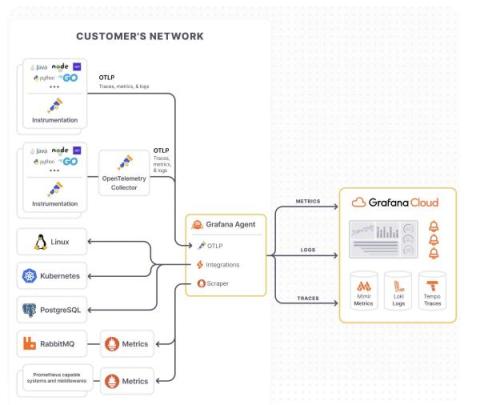
OpenTelemetry best practices: A user's guide to getting started with OpenTelemetry

If you’ve landed on this blog, you’re likely either considering starting your OpenTelemetry journey or you are well on your way. As OpenTelemetry adoption has grown, not only within the observability community but also internally at Grafana Labs and among our users, we frequently get requests around how to best implement an OpenTelemetry strategy.

Rollbar Alternatives: Compare Before You Commit

Rollbar is acclaimed as the top error monitoring tool - with 4.5 out of 5 stars on both Capterra and G2 - amongst a competitive field. That said, we recognize there are alternatives some people consider when also looking at us. Here is our perspective on what these other tools are for, and when to choose Rollbar instead.

The Advent of Monitoring, Day 10: Better Observability Into Your Local Clickhouse Instance With Grafana and Prometheus

Cloud-based database providers often provide great observability out of the box. But, what if you’re developing a tricky feature locally and need more details about what your local Clickhouse is doing? There are many options, but if you’re a numbers and graphs person like me, you’ll want to be able to view the inner workings of Clickhouse in something like Grafana.

AWS re:Invent Recap!

Cribl’s usual suspects, Ed Bailey and Jackie McGuire, are joined by Sr Partner Marketing Manager Michelle Zhang to discuss our experiences at AWS re:Invent this past November. It was a great event, and we want to share the top themes and presentations we saw at the show. Michelle will share her experience building and strengthening Cribl’s strategic alliance network and some of the "better together" progress made over the past year for customers.

AI microscopy with Grafana, Theia Scientific, and Volkov Labs (Grafana Office Hours #24)

What do you get when you combine AI microscopy with Grafana? Well, in this case, you get the Theiascope platform: an application for doing real-time analysis on microscopy images using a combination of Grafana, Prometheus, and PostgreSQL/Timescale. The Theiascope platform was a collaboration between Dr. Christopher Field, Co-Founder/President/ Principal Investigator at Theia Scientific and Mikhail Volkov, Founder/CEO of Volkov Labs. Christopher and Mikhail are joined by Developer Advocates Paul Balogh and Nicole van der Hoeven.

The Advent of Monitoring, Day 9: Advantages of Multi-Step API Checks vs Original API Checks

This is the ninth part of our 12-day Advent of Monitoring series. In this series, Checkly's engineers will share practical monitoring tips from their own experience. As a Checkly user, you’ve always had access to our two core check types: API and browser checks. API Checks are much cheaper, and therefore only run a curl-like request against the endpoint of your choice.

[Webinar] Mastering log monitoring: Strategies for enhanced application failure troubleshooting

Are you fed up with web server failures or slowness? Are you struggling with an overwhelming amount of log data to analyze? Comprehensive log analysis offers complete visibility into your infrastructure, resulting in effective troubleshooting. This webinar helps you learn proven log monitoring techniques to tackle application failures and keep your systems running smoothly. In this session, we'll discuss: Analyzing large volumes of log data to detect issues and determine their causes Practical examples from real-world cases to hone your troubleshooting skills.

What is SSH?

SSH stands for “Secure Shell.” It’s a network protocol used to securely access and manage devices and servers over an unsecured network. It provides an accurate form of authentication as well as encrypted communication between two systems, making it especially useful in environments where security is a concern. SSH is commonly used to access remote servers through a command line interface, but can also be used to securely transfer files (through SFTP or SCP).

What is the principle of least privilege (PoLP)?

The Principle of Least Privilege, also known as PoLP, is a computer security rule that states that each user or group of users must have only the necessary permissions to perform their corresponding tasks. In other words, the less power a user has, the lower the chances of them having a harmful impact on the business.