Operations | Monitoring | ITSM | DevOps | Cloud

The latest News and Information on Databases and related technologies.

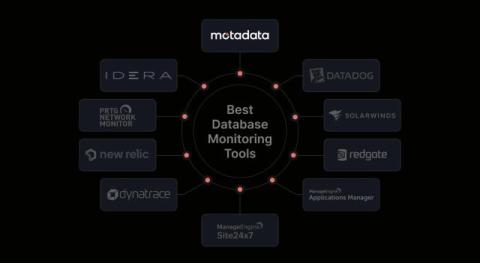
10 Best Database Monitoring Tools for 2026

If your company relies on multiple databases and applications, keeping track of database performance can become difficult. You may face challenges such as: As your database environment grows, identifying the cause of performance issues becomes harder without the right monitoring in place. I get why database monitoring tools have become an important part of managing database performance. They help you monitor database activity, spot performance issues, and find what is causing a slowdown.
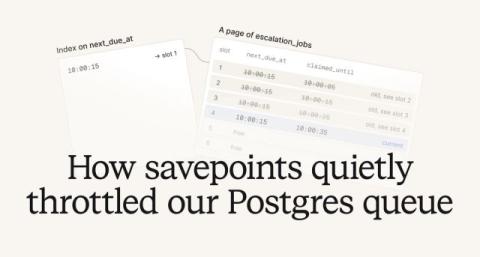
How savepoints quietly throttled our Postgres queue

At incident.io we are huge fans of Postgres; we've written about it a lot over the years, including how to choose the right indexes and how we're proud of being boring (The Pet Shop Boys). We use Postgres as our primary transactional database, which as of today has ~900 tables, and counting! The vast majority of our codebase does something along the following lines: read some data from Postgres, execute some business logic, then write that data back to Postgres. It is not, however, always that simple.

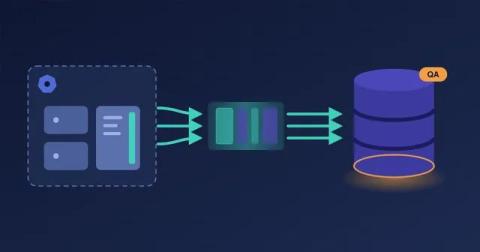
Load Test PostgreSQL Instantly using Production Recordings

The first PostgreSQL post ran on a laptop: a demo app, a Docker container, and the proxymock CLI. That is the fastest way to see the idea. It is also not where your database problems live. Your real query mix lives in the cluster, where a Java service with a connection pool, an ORM and a schema migration tool sends the statements nobody wrote by hand. This post deploys an open source banking app to Kubernetes and records the queries one of its services sends to PostgreSQL.

The Year-2 Price Cliff: What Your Observability Stack Really Costs Over 3 Years

I’m not the one whose phone lights up at 3 a.m. when production breaks. But I’ve spent years working alongside the engineers who are, and I’ve noticed that observability migrations happen for two reasons. Either engineering needed one, or, far more often, a quote landed that looked too good to refuse. The engineers rarely regret the first kind. The second kind they tell me about in year two, usually with a renewal notice in hand.

The hidden costs of AI (and who ends up paying them) | The Simple Talk Podcast

AI budgets are escalating rapidly, yet few teams measure the value of their spend – and who ends up paying, anyway? The Redgate Advocates discuss that, LLMs, data centers, regulation, what happens to the next generation of engineers if they never learn to solve problems the hard way – and more.

Devart Data Access Components add support for the latest IDEs and database platforms

The latest update to Devart Data Access Components is here, bringing support for RAD Studio 13 Florence Release 2, Lazarus 4.8, Microsoft SQL Server 2025, MySQL 9.7.x, and NexusDB 4.75.20. The release also introduces new security and authentication capabilities, along with improvements to transaction management, database connectivity, data handling, and performance.

Database change management on Databricks: migrations, environments, and AI-generated change

You wouldn’t ship untested SQL Server database changes – Why is Databricks different? Databricks is where the data estate is growing, and increasingly where AI workloads run and generate change. But schema change there still happens the hard way: views and stored procedures managed through manually versioned scripts, drift between workspaces discovered when a deployment fails, and no reliable record of what changed, when, where, or why. As AI raises the volume and speed of schema change, these gaps widen.

How Linux readahead works, and the two ways to change it

Most of the time, when we read a file, we do not think much about what happens underneath. You ask for some bytes, you get some bytes. But when getting data off the disk efficiently is at the core of what your application does, what happens underneath starts to matter a great deal, and two identical read() calls can differ enormously in what they cost. So in this post we are going to look at one of the Linux kernel’s optimizations for reading files: readahead.

Oracle database DevOps: automating schema changes for Oracle

Learn how to safely automate Oracle schema changes. Discover what makes Oracle database DevOps unique. Automating Oracle schema changes safely means considering what makes Oracle different. A real Oracle database DevOps practice pairs version-controlled changelogs and pipeline integration with policy-as-code protection, pre-flight checks, and tested rollback scripts, so schema changes deploy with the same speed and safety as application code.

VictoriaTraces in VictoriaMetrics Cloud: Complete Observability is Here

Earlier this year, we launched VictoriaLogs in VictoriaMetrics Cloud, bringing fast and cost-effective log management to everyone. Today we launch the final major step toward full observability: VictoriaTraces is now available to all cloud users. With this release, you can now manage all three signals, metrics, logs, and traces, in one place with the predictable pricing, reliability, and the operational simplicity you’ve come to expect from VictoriaMetrics.