Operations | Monitoring | ITSM | DevOps | Cloud

Observability Lessons NVIDIA and CoreWeave

The best thing that can happen to an open-source project is to find its way into some of the world’s largest technology companies. In September 2026, this happened twice in one week: VictoriaMetrics is now officially bundled in the self-managed edition of NVIDIA’s Cloud Functions, and I learned that CoreWeave is using VictoriaMetrics as the metrics backend for all of its infrastructure customers. Both companies adopted VictoriaMetrics independently.
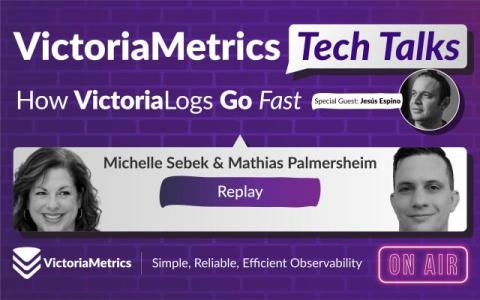
Go, Logs and the Engineering Behind VictoriaLogs Performance

What actually makes a logging system fast? That was the question behind Tech Talk. And if you were expecting the answer to be a collection of clever Go optimizations, Jesús Espino, Principal Engineer at VictoriaMetrics, made an important point pretty early in our conversation: A huge part of VictoriaLogs’ performance comes from architecture and data structures. The micro-optimizations come later. Now that gave my Tech Talk partner in crime, Mathias Palmersheim, and me plenty to dig into.

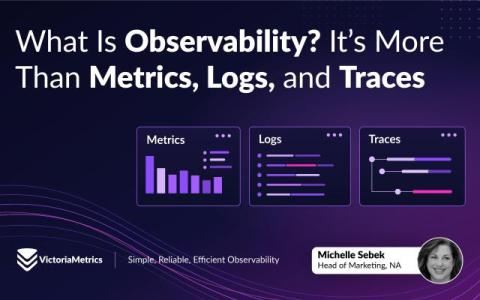
What Is Observability? It's More Than Metrics, Logs, and Traces

Modern systems, due to their distributed nature, rarely fail in simple ways. A request might pass through an API gateway, several microservices, a database, a message queue, and a third-party service before a response ever reaches a user. When something slows down or breaks, knowing that something is wrong is only the beginning. You need to figure out.

VictoriaLogs Has Now a Long Term Support (LTS) Release

VictoriaLogs now runs in production everywhere, and many teams running it have told us the same thing: everyone wants new features, but it’s hard to keep upgrading their logging backend every few weeks. They want the mix of stability and up-to-date security that only LTS releases can satisfy. We’re happy to announce the first Long Term Support (LTS) release of VictoriaLogs: v1.52.1. This is the start of a new v1.52.x LTS line.

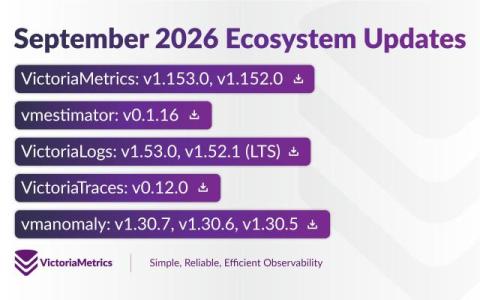
VictoriaMetrics September 2026 Ecosystem Updates

Another month whooshed by, bringing a slew of updates: 3 vmanomaly and 2 VictoriaMetrics releases, and new versions of vmestimator, VictoriaTraces, and our first ever LTS release of VictoriaLogs. This brings 12 months of stability to VictoriaLogs Enterprise users. But the big one was the launch of VictoriaTraces on VictoriaMetrics Cloud. Finally, we can offer a complete managed observability stack with metrics, logs, and traces. We run it, you use it. This ecosystem update includes.

The Data Race That Wasn't a Bug (and the One That Was)

Imagine this: you are testing the performance of some part of your application. Everything is going smoothly, the numbers look good, and as a last check you turn on Go’s race detector. Then, out of nowhere, it prints a warning you didn’t expect: So you look at it. You look at it again, and again, and you think: “What the…?” The race is between your code and a goroutine you never started, somewhere deep inside net/http. You have no idea how that is possible, or why.

The Year-2 Price Cliff: What Your Observability Stack Really Costs Over 3 Years

I’m not the one whose phone lights up at 3 a.m. when production breaks. But I’ve spent years working alongside the engineers who are, and I’ve noticed that observability migrations happen for two reasons. Either engineering needed one, or, far more often, a quote landed that looked too good to refuse. The engineers rarely regret the first kind. The second kind they tell me about in year two, usually with a renewal notice in hand.

Telemetry Talks ep 8 - Fireside chat with OpenTelemetry maintainers

Telemetry Talks episode 8 is here We sat down with OTel maintainers to talk about the future of the community, GenAI semantic conventions, contributing beyond code, OTel in Practice, and what they’re currently building, writing, organizing, and experimenting with across the CloudNative and OpenSource ecosystem. A conversation about where OTel is today and what comes next. Playlist Resources for Further Learning.

How Linux readahead works, and the two ways to change it

Most of the time, when we read a file, we do not think much about what happens underneath. You ask for some bytes, you get some bytes. But when getting data off the disk efficiently is at the core of what your application does, what happens underneath starts to matter a great deal, and two identical read() calls can differ enormously in what they cost. So in this post we are going to look at one of the Linux kernel’s optimizations for reading files: readahead.

VictoriaTraces in VictoriaMetrics Cloud: Complete Observability is Here

Earlier this year, we launched VictoriaLogs in VictoriaMetrics Cloud, bringing fast and cost-effective log management to everyone. Today we launch the final major step toward full observability: VictoriaTraces is now available to all cloud users. With this release, you can now manage all three signals, metrics, logs, and traces, in one place with the predictable pricing, reliability, and the operational simplicity you’ve come to expect from VictoriaMetrics.