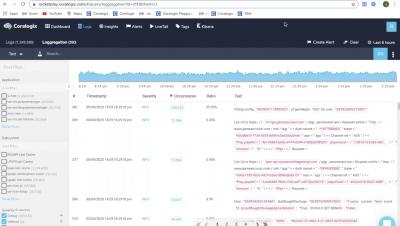

At Logz.io, our team has the opportunity to partner with many cutting edge technology companies and products from different trades. Many have a crucial mission and help save lives worldwide. In the fight against the novel coronavirus, telehealth is one such sector. It compels us to do all we can to support these organizations by improving application accessibility and performance for users who need it. One of our customers epitomizes this—Tyto Care. Tyto Care is a healthcare pioneer.
A classic problem that every backend developer has faced during their work is testing an application that uses a database. A perfectly valid solution is to use the real database for testing your application, but you would be doing an integration test, while you want a unit test. There are many ways to solve this problem. You could create the database with docker, or use an in-memory compatible one, but if you are writing unit tests that can be easily parallelized this will become quite uncomfortable.
We are offering a variety of on-demand Elastic training courses for free — featuring 11 titles that span observability, security, and Elastic Stack administration. If you haven’t tried one of our self-paced courses yet, now is the perfect time to find out why so many people have shifted their learning preference from in-class to online. Our on-demand courses provide the same immersive learning experience found in the classroom, but delivered in a convenient, remote environment.
Elasticsearch allows you to store, search, and analyze large amounts of structured and unstructured data. This speed, scale, and flexibility makes the Elastic Stack a powerful solution for a wide variety of use cases, like system observability, security (threat hunting and prevention), enterprise search, and more. Because of this flexibility, effectively architecting your deployment’s data storage for scale is incredibly important.
Apache Arrow, a specification for an in memory columnar data format, and associated projects: Parquet for compressed on disk data, Flight for highly efficient RPC, and other projects for in-memory query processing will likely shape the future of OLAP and data warehousing systems. This will mostly be driven by the promise of interoperability between projects, paired with massive performance gains for pushing and pulling data in and out of big data systems.
In this article, we’ll learn about the Elasticsearch flattened datatype which was introduced in order to better handle documents that contain a large or unknown number of fields. The lesson examples were formed within the context of a centralized logging solution, but the same principles generally apply. By default, Elasticsearch maps fields contained in documents automatically as they’re ingested.