Operations | Monitoring | ITSM | DevOps | Cloud

HAProxyConf 2019 - How OUI.sncf Built Its CDN with HAProxy by Antonin Mellier and Nicolas Besin

Oui.sncf sells tickets and passes for rail travel around Europe. We operate the #1 French e-commerce website with more than 83 million travel products sold and more than 12 million unique visitors per month. We’ve been using HAProxy since 2009. When we decided to build our own CDN solution in 2015, we knew we’d include HAProxy as a main component. In this talk, we will show you how HAProxy is integrated into our CDN infrastructure and how we use it daily to manage, update, configure, and troubleshoot our infrastructure.


HAProxyConf 2019 - Inspect, Control, Report: HAProxy as the SRE's Door Man by Daniel Schneller

CenterDevice offers secure document storage and sharing with OCR, full-text indexing and automatic versioning. Our SREs use HAProxy to gain insights into the usage of our services, diagnose issues, and throttle or reject requests based on HAProxy ACLs. In this talk, you will see how we generate HAProxy configuration files using templates. We will describe our custom log format and demonstrate how we integrate HAProxy data with Kibana.

Lessons Learned Implementing ChatOps

Email overload, distributed teams and excessive meetings have caused many organizations to move their DevOps teams to messaging platforms and thus adopt ChatOps workflows. With thousands of open source installs and hundreds of customer implementations, we have a few lessons to share on interesting DevOps workflows, how incidents can be effectively communicated across distributed teams and what messaging in secure and regulated environments should look like.

Lessons Learned Building Messaging Software with a Fully Remote Team

Our experience working with hundreds of customers who use Mattermost, an open source messaging workspace, and a distributed team with hundreds of additional contributors all working remotely, has taught us several lessons about communications tools and how to get work done across time zones.

DevOps 101: Container Registries

This is a repost from the JFrog dev.io blog site. When you’re new to an industry, you encounter a lot of new concepts. This can make it really difficult to get your feet underneath you on an unfamiliar landscape, especially for junior engineers. In this series, I’ll cover tools and terminology common to the DevOps space, plus the occasional newbie-friendly tutorial for emerging or established technologies. If you have a request or suggestion, let me know!

Five Security Priorities to Consider With a Remote Workforce

Many organizations are prioritizing the health and well being of their workforce in the wake of the current global pandemic. Many threat actors are also taking advantage of this opportunity. I’ve seen recent examples of social engineering—with calculated phishing campaigns preying on those who seek information on the COVID-19. As noted by Security Researcher Brian Krebs, one hacker group even used a copy of a legitimate map of the impact of the virus to infect machines with malware.

How ITSM Can Support an Emergency Response Plan

As federal, state, and local government agencies scramble to create emergency response processes and procedures, be advised that IT service management (ITSM) can play a critical role in supporting emergency response plans and associated processes. Government and commercial business emergency response plans define how agencies and commercial organizations respond to catastrophic events in the environment.

Virtualizing a Network Operations Center

A Network Operations Center (NOC) is a location from which IT support technicians can supervise, monitor, and maintain client networks and infrastructure. Because they act as a central nervous system for many organizations, NOCs are typically located in a central physical location. The global coronavirus (COVID-19) pandemic is an unprecedented situation that is creating new challenges for everyone—and that includes NOCs.

Challenges with Implementing SLOs

A few months ago, Honeycomb released our SLO — Service Level Objective — feature to the world. We’ve written before about how to use it and some of the use scenarios. Today, I’d like to say a little more about how the feature has evolved, and what we did in the process of creating it. (Some of these notes are based on my talk, “Pitfalls in Measuring SLOs;” you can find the slides to that talk here, or view the video on our Honeycomb Talks page).

Elastic APM adopts W3C TraceContext

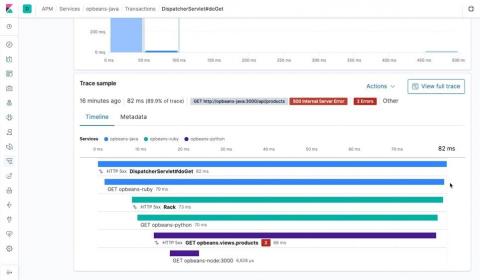
Distributed tracing remains one of the most important features of any tracing system. Nearly a year ago, we announced Elastic APM distributed tracing, let’s take a look at how this useful feature works behind the scenes. Over the past few years, many applications have adopted microservice architecture. Each of the services in a microservice architecture can have their own instrumentation to provide observability into the service.