Within the initial blog in this series, we discussed ransomware attacks and their remediation on Android mobile devices. Part 2 addresses potential ransomware exploits and their remediation on iOS, iPadOS mobile devices and macOS desktops.
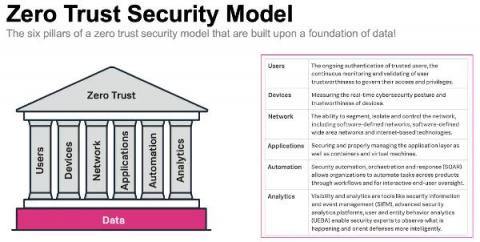
A May 2021 executive order mandated that federal government agencies invest in both technology and personnel to centralize and streamline access to cybersecurity data, accelerate migration to secure cloud architectures, and advance toward a zero-trust architecture. A zero-trust architecture doesn’t refer to a predefined, out-of-the-box network security solution. It’s a strategy based on an agency’s cybersecurity plan that contains a collection of zero-trust concepts.
Public sector organisations are in the middle of a massive digital transformation. Technology advances like cloud, mobile, microservices and more are transforming the public sector to help them deliver services as efficiently as commercial businesses, meet growing mission-critical demands, and keep up with market expectations and be more agile.
Ransomware is a strain of malware that blocks users (or a company) from accessing their personal data or apps on infected iOS, iPadOS, and Android mobile devices, macOS laptops, Windows personal computers and servers, and Linux servers. Then the exploit demands cryptocurrency as payment to unblock the locked or encrypted data and apps. This form of cyber extortion has been increasing in frequency and ferocity over the past several years.
Covid made the hypothetical necessity of IT risk planning a reality. Many organizations responded to the immediate need for remote workforces by adding more VPN licenses. But while adding more VPN capacity solved the problem of resource access, it also led to network bottlenecks and application latencies.
As you may have heard, Ivanti was selected by the National Institute of Standards and Technology’s (NIST’s) National Cybersecurity Center of Excellence (NCCoE) to participate as a collaborator in its Implementing a Zero Trust Architecture project.
Five worthy reads is a regular column on five noteworthy items we’ve discovered while researching trending and timeless topics. This week, we explore why organizations should implement Zero Trust in 2021. In 2010, John Kindervag introduced the concept of “Zero Trust” which has become a touchstone for cyber resilience and persistent security. Zero Trust is not a security product, architecture, or technology.
At the start of the pandemic, IT organizations had to undergo radical changes to support remote work. Given the urgency to shift to remote operations, IT admins opted for band-aid solutions to retain business continuity and stay connected to the core of their networks from remote locations. But now, many organizations are moving toward hybrid workforce options with employees choosing to work from both their home and office locations.
AI monitoring technologies have the potential to introduce significant cost savings for CSPs. Based on machine learning and fully autonomous, these monitoring solutions provide high ROI by dramatically reducing Time to Detection (TTR), Time to Resolution (TTR), the total number of alerts, and the number of false positives and negatives.