Operations | Monitoring | ITSM | DevOps | Cloud

The latest News and Information on Log Management, Log Analytics and related technologies.

How search accelerates your path to "AI first"

The combination of AI and search enables new levels of enterprise intelligence, with technologies such as natural language processing (NLP), machine learning (ML)-based relevancy, vector/semantic search, and large language models (LLMs) helping organizations finally unlock the value of unanalyzed data. Search and knowledge discovery technology is required for organizations to uncover, analyze, and utilize key data.

Simplifying Your Data Node Migration with Graylog

Migrating your data infrastructure can sound daunting, especially when you’re dealing with complex systems like OpenSearch. But what if it could be easier—almost ridiculously easy? If you’re thinking, “Hey, wait a second—could this be as seamless as it sounds?” You’re in for a pleasant surprise. In this blog, we’re diving into how moving and Simplifying Your Data Node Migration with Graylog makes the process smooth, secure, and efficient.

Java Logging Basics: Concepts, Tools, and Best Practices

Imagine you’re a detective trying to solve a crime, but all the evidence is invisible. Sounds impossible, right? That’s exactly what it’s like trying to debug a Java application without proper logging. Java logging is your magnifying glass, your fingerprint kit, and your trusty notepad all rolled into one. It’s the unsung hero that helps you understand what’s going on under the hood of your application. But logging isn’t just about catching bugs.

Troubleshooting Microservices with Splunk Observability Cloud and the AI Assistant for Observability

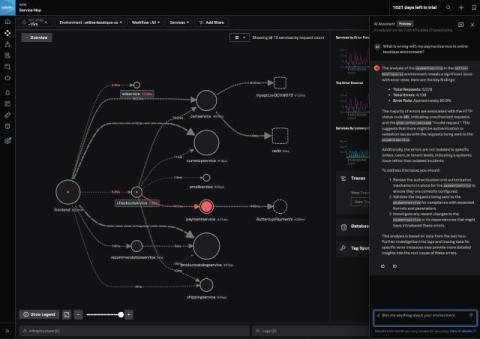
In this video, I’m going show you how to troubleshoot microservices in Splunk Observability Cloud using features like APM’s Service Map and Tag Spotlight to identify what’s causing our microservice to produce high error rates. We’ll then review Related Logs in Log Observer to determine why the error in our service is occurring.

The new era of observability: Why logs matter more than ever

20 years ago, software ate the world. The old ways of monitoring, failing over, or routinely rebooting quickly became inadequate and with a new focus on software excellence, how we monitor and maintain them had to be rethought. Even back then, when new software was released on an annual basis, it was clear that developers and futurists needed to build, inform, and optimize their approach, which required a deeper understanding of the application experience.

Top Tips for Querying OpenSearch

OpenSearch allows you to store a sizeable amount of data, commonly logs, metrics, and documents. You access useful data within OpenSearch by querying to get specific information, deep analysis, and insights for decision-making. With OpenSearch, you can perform complex searches by using natural language, Boolean operators, and filters to pinpoint relevant information efficiently.

Revisiting improved HTTP logging in ASP.NET Core 8

A few years ago, I had a play with HTTP logging added in ASP.NET Core 6. ASP.NET Core 8 introduced a set of additional configuration options that I believe are essential to make this feature usable. I will recap the details from the previous post below, but for more context, the first part of this series is here. In this post, I'll go through some of the changes introduced in HTTP logging since last. Before I jump into the improvements, let's recap how to set up HTTP logging.

How to Build a Data Migration Plan? A Step By Step Guide

Data growth is growing at an extraordinary pace, with a compound annual growth rate (CAGR) of 28% projected over the next few years. For organizations dealing with logs, metrics, and traces, this massive data expansion brings both opportunities and challenges. As data volumes soar, having flexibility in where you store and analyze it—whether in a SIEM, object storage, or other platforms—has become essential.