Operations | Monitoring | ITSM | DevOps | Cloud

N+1 Queries in Rails: A Guide to Detection and Prevention

N+1 queries are the most common performance problem in Rails applications. ActiveRecord’s lazy loading means every belongs_to, has_many, and has_one association is a potential N+1 waiting to happen. The good news is that Rails gives you multiple ways to fix them, and tools like Scout can find them automatically. This guide covers everything a Rails developer needs to know about N+1 queries: what they are, how to fix them, how to prevent them in CI, and how to detect them in production.

Azure Monitor Collector: Monitor Your Entire Azure Infrastructure From Netdata

If you’re running infrastructure on Azure, you’ve probably dealt with the split between your Azure-native monitoring and the rest of your stack. Your VMs, databases, and Kubernetes clusters generate platform metrics through Azure Monitor, but those metrics live in a separate world from the OS-level, application, and on-prem metrics you’re already watching in Netdata.

Not All Telemetry Requires Premium Pricing

Observability in software is often framed as a choice between self-hosted and SaaS: manage it yourself, or pay a vendor to handle your data. Both self-hosted and SaaS approaches have their merits, but assuming you must choose one exclusively over the other leads to poor trade-offs: either overcommitting to an all-in-one SaaS despite spiraling costs, or fully self-hosting when it’s unnecessary.

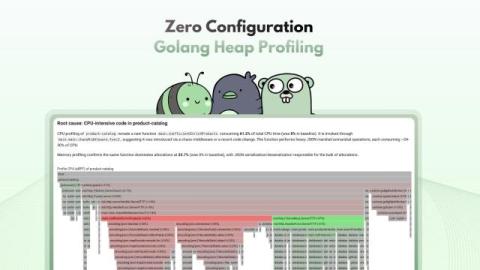
Zero-config Go heap profiling

Coroot's node-agent already collects CPU profiles for any process on the node using eBPF, with zero integration from the application side. For Java, we dynamically inject async-profiler into the JVM to get memory and lock profiles. But Go processes were still a blind spot for non-CPU profiling unless the app exposed a pprof endpoint and the cluster-agent scraped it. We wanted the same zero-config experience for Go heap profiles. This post is about how we got there.

Jira GitHub Integration: The Complete Guide

Most teams use Jira to plan work and GitHub to build it. The problem is those two tools don’t talk to each other by default. Developers end up manually copying commit references into tickets, project managers hunt through GitHub to answer basic status questions, and sprint reviews become archaeology expeditions through two disconnected systems. Git Integration for Jira closes that gap.

SRE agent vs. traditional engineer: 7 key differences

The role of a Site Reliability Engineer (SRE) is evolving. The focus has shifted from simply working harder during an outage; A new kind of teammate is here to help: the SRE Agent. But what are the key differences when you compare an SRE agent versus a traditional site reliability engineer? This isn’t just a superficial change. It signifies a fundamental alteration in how teams construct and sustain dependable services.

Understanding disaggregated GenAI model serving with llm-d

llm-d is an open source solution for managing high-scale, high-performance Large Language Model (LLM) deployments. LLMs are at the heart of generative AI – so when you chat with ChatGPT or Gemini, you’re talking to an LLM. Simple LLM deployments – where an LLM is deployed to a single server – can suffer from latency issues, even with just one user. This can be because of lack of memory-bandwidth on the server, or because of KV cache pressure on system memory.

Eliminate Manual Authentication Configuration for Fast & Effective API Security Scanning | Harness Blog

Application security testing tools promise coverage and accuracy, but teams often struggle just to get started. One of the biggest friction points in dynamic application security testing is configuring authentication correctly so a scanner can even access a target application, let alone API endpoints that power the functionality. Whether it’s API keys, bearer tokens, or custom auth flows, setting up authentication for scans frequently requires trial-and-error and engineering support.

All You Need to Know About CrashLoopBackOff Error

Kubernetes is an open-source container orchestration engine that is used to automate containerized application deployment, scaling, and administration. It is an open-source management platform that can be used to manage containerized workloads and services, as well as declarative configuration and automation. Kubernetes is a framework for running distributed systems in a resilient manner. It handles scaling and failover for your application and provides deployment patterns and other features.