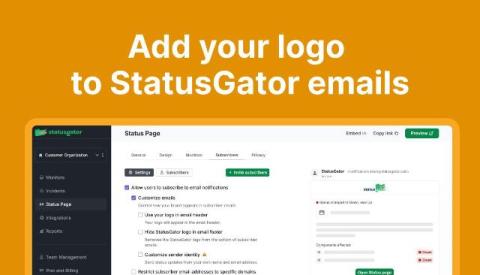
You can now customize the logo shown in your email header on all paid plans. We’ve also updated how email customization works in StatusGator to make branding options clearer and easier to manage.
Migrating to SAP S/4HANA is one of the most consequential system changes your organization will undertake. The technical complexity alone is significant. But the real risk is operational: maintaining uninterrupted service delivery while transforming the core systems your business depends on. Failure to manage this well causes outages, data inconsistencies, user disruption, and cost overruns. None of those are acceptable outcomes. The good news is these risks are manageable.
Checkly is a modern reliability platform that combines testing, monitoring and observability in one place. Its integration with Playwright and languages such as TypeScript means that developers can write tests using tools they are familiar with and then run them in Checkly. Its Monitoring as Code philosophy also means that Checkly tests can be incorporated into CI/CD pipelines.
Honeycomb is proud to share that we have achieved the Amazon Web Services (AWS) Financial Services Competency. This recognition validates our technical expertise and proven customer success in assisting financial services organizations with building, running, and understanding their production systems on AWS. Securing this competency is a direct response to our customers’ feedback in this space: observability in regulated, high-stakes environments requires more than dashboards and alerts.
The dashboard says you can save 30%. The SRE team won’t sign off. You’ve probably been in this meeting. Finance has a number. The platform team has a scar. Somewhere between them sits a senior manager, maybe you, being asked to choose a cost optimization tool that one side will champion and the other side will quietly refuse to deploy in production. The standoff isn’t about price. It’s about trust.
You requested, we implemented it. OnPage’s new web console with an improved and more modern interface design is coming to you in the next few days! But we’re aware of how difficult it is to introduce change for healthcare organizations. Not because clinicians and hospital admins are averse to learning new tools. But more so because they’re wary of anything that may come in between them and their patients, taking away their valuable time from care delivery.
Every enterprise is building AI agents. Marketing has one summarizing campaign performance. Engineering has one triaging incidents. Customer support has one resolving tickets. Finance has one processing invoices. Each was built by a different team, using a different framework, with different assumptions about security. Now those agents are talking to each other through agent-to-agent (A2A) communication. The incident-triage agent calls the customer-support agent to check affected accounts.
Running VMs in Kubernetes sounds like a crazy workaround for avoiding vendor lock-in, and standardizing legacy applications and newer containerized workloads on one control plane with one set of security policies to govern them all. It is, however, a rapidly growing pattern, and KubeVirt live migration — moving running VMs between nodes without downtime — is increasingly central to platform engineering use cases that require full VMs, like on-demand CI/CD pipelines.
The thing with Change Advisory Boards is that the intent was always good. Get smart people in a room, look at the evidence, and make sure nothing catastrophic goes out the door. In theory, that's hard to argue with. It doesn't scale in practice. Things happen between meetings. Teams rush to hit the window. The CAB meeting may not catch every risky deployment, but at least everyone can feel good about the process before the incident happens. Automated release management asks a different question entirely.