Operations | Monitoring | ITSM | DevOps | Cloud

What Top Brands Are Saying About Splunk Observability Cloud

Customers have had a lot to say about the new Splunk Observability Cloud since we announced general availability on May 5, 2021. For the first time ever, IT and DevOps teams can get all their data in one place with unified metrics, traces and logs — collected in real time, without sampling and at any scale. What makes Splunk Observability Cloud unique from other solutions? We’ll let our customers do the talking.

Designing Honeycomb for Our Users

You might have noticed some visual changes happening in Honeycomb lately. Colors, typography, icons, and some features have started to look a bit different. While these changes are just beginning to make their way into the product, we’ve been working on them for some time. Let’s look at what has been going on behind the scenes to make them happen.

How to Use Observability to Reduce MTTR

When you’re operating a web application, the last thing you want to hear is “the site is down." Regardless of the reason, the fact that it is down is enough to cause anyone responsible for an app to break out into a sweat. As soon as you become aware of an issue, a clock starts ticking — literally, in some cases — to get the issue fixed. Minimizing this time between an issue occurring and its resolution is arguably the number one goal for any operations team.

Leverage Observability With OpenTelemetry to Understand Root Cause Quickly

An observability solution should help any incident responder understand what changed and why. A lot has been written on the difference between monitoring and observability, but an easy way to understand how both are integral to incident response is to consider how customers use PagerDuty—with both monitoring and observability tools—to get to the right answer.

Data Availability Isn't Observability

But it’s better than nothing… Most of the industry is racing to adopt better observability practices, and they’re discovering lots of power in being able to see and measure what their systems are doing. High data availability is better than none, so for the time being, what we get is often impressive. There’s a qualitative difference between observability and data availability, and this post aims to highlight it and orient how we structure our telemetry.

The State of Observability in 2021

Today, we released our second annual Observability Maturity Community Research Findings report. This year-over-year report identifies trends occurring in the observability community that we use to further develop our Observability Maturity Model. Our goal in running this annual report is to understand community perceptions and awareness of observability, how engineering teams are approaching observability, and mapping an observability maturity model that reflects current research findings.

A New Approach to Metrics

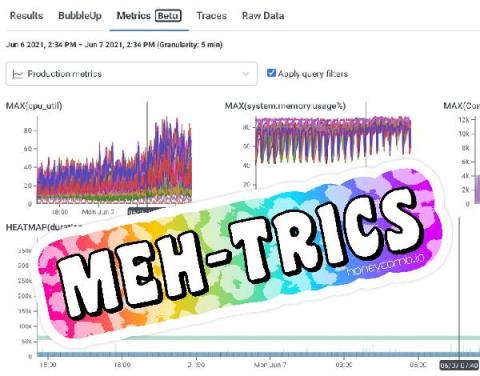
Today at o11ycon+hnycon—right now, actually, if you’re reading this blog when it was posted—we’re announcing several new Honeycomb features during the keynote. Our industry and community have come a long way since we burst onto the scene, and I’m delighted to give you another version of Honeycomb that continues to demonstrate what’s possible with observability. And it includes metrics.

Multi-Project Cloud Monitoring made easier

Customers need scale and flexibility from their cloud and this extends into supporting services such as monitoring and logging. Google Cloud’s Monitoring and Logging observability services are built on the same platforms used by all of Google that handle over 16 million metrics queries per second, 2.5 exabytes of logs per month, and over 14 quadrillion metric points on disk, as of 2020.

Unified Observability: A Business-Centric View

Here at LogicMonitor, we’re on a mission to build the most comprehensive, extensible, and intelligent monitoring and observability platform in the world to help businesses run seamlessly. We’ve spent more than a decade building a best-in-class monitoring platform. Over the past two years, however, we have further evolved our platform to deliver invaluable end-to-end observability across applications, networks, and infrastructure for companies of all sizes and in a variety of industries.