Operations | Monitoring | ITSM | DevOps | Cloud

Tracing AWS Lambdas with OpenTelemetry and Elastic Observability

Open Telemetry represents an effort to combine distributed tracing, metrics and logging into a single set of system components and language-specific libraries. Recently, OpenTelemetry became a CNCF incubating project, but it already enjoys quite a significant community and vendor support. OpenTelemetry defines itself as “an observability framework for cloud-native software”, although it should be able to cover more than what we know as “cloud-native software”.
An Introduction to Distributed Tracing

There’s no strict definition of a distributed system. But generally speaking, if you have reached a point where you’re running more than five interdependent services at once, that means you’re running a distributed system. It also means you are more than likely experiencing difficulties when troubleshooting using traditional debugging tools. Unfortunately, pulling up multiple tools, each built for a monolithic world, doesn’t help pinpoint the problem.

Java Application Manual Instrumentation for Distributed Traces

In this blog series, we are covering application instrumentation steps for distributed tracing with OpenTelemetry standards across multiple languages. Earlier, we covered Golang Application Instrumentation for Distributed Traces and DotNet Application Instrumentation for Distributed Traces. Here we are going to cover the instrumentation for Java.

The Stanza Story

We launched the Stanza log agent just over one year ago. Stanza is the result of an uncompromising stance on performance, processing, and configurability for log telemetry. It took mere days for friends and colleagues in the space to raise the obvious objection – there are already so many logging agents, so why spend time on a *new* one? We also heard from competitors who had a snarkier take…

Distributed Tracing for C++ Applications with OpenTelemetry & Logz.io

Many organizations are moving from monolithic to microservices-based architectures. Microservices allow them to improve their agility and provide features more quickly. Although developing a single microservice is simpler, the complexity of the overall system is much greater. Here, we’ll review how to add distributed tracing to C++ with the OpenTelemetry collector and send to Logz.io. One of the biggest challenges is finding efficient tools to quickly debug and solve production problems.

Honeycomb Is All-In on OpenTelemetry

OpenTelemetry (or “OTel”) helps you get your instrumentation started quickly, and it helps you get the most out of that telemetry data by providing flexible exporting options. As a result, it’s emerging as the new standard for instrumentation. To that end, today we’re sharing more insight into the work we’ve done (and are doing) to enable a path for all Honeycomb users toward OTel adoption. We hope you’ll be as excited as we are to embrace these open standards!

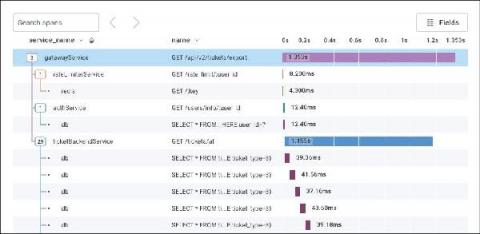
Queryless vs. Query-less. Faster Insights and Better Observer Experience with Span Analytics

In one of my previous blogs I explained how important it is for a modern observability platform to provide “the observers” full, flexible access to all raw telemetry. Observability’s promise to find unknown unknowns relied directly on the ability of fast, powerful and multidimensional high-cardinality analysis of raw data, to uncover previously unknown patterns that have not yet been visualized as a metric, dashboard panel or an alert or anomaly event.