Operations | Monitoring | ITSM | DevOps | Cloud

Telemetry Data Compliance Module

Telemetry data sent from applications often contains Personally Identifying Information (PII) like names, user IDs, phone numbers, and other information that must be obfuscated before the data is sent to storage or observability tools, in order to be in compliance with corporate or government policies such as HIPAA in the US or the GDPR in the EU.

My 3 Lessons About OpenTelemetry for Observability

As a fan of OpenTelemetry, I love to see Cribl meeting customers where they are and helping them get to where they want to be with a vendor-agnostic approach. Where it is not possible or practical to re-instrument a telemetry source, whether an application or infrastructure, the barrier to adopting OpenTelemetry Signals can be daunting.

How to Monitor Host Metrics with OpenTelemetry

Today's environments often present the challenge of collecting data from various sources, such as multi-cloud, hybrid on-premises/cloud, or both. Each cloud provider has its own tools that send data to their respective telemetry platforms. OpenTelemetry can monitor cloud VMs, on-premises VMs, and bare metal systems and send all data to a unified monitoring platform. This applies across multiple operating systems and vendors.

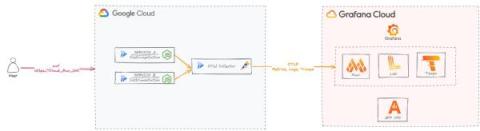
Serverless observability: How to monitor Google Cloud Run with OpenTelemetry and Grafana Cloud

OpenTelemetry has emerged as the go-to open source solution for collecting telemetry data, including traces, metrics, and logs. What’s especially unique about the project is its focus on breaking free from the reliance on proprietary code to offer users greater control and flexibility. As a senior solutions engineer here at Grafana Labs, I’ve spent a lot of time exploring OpenTelemetry, including in my spare time.

Spans - a key concept of distributed tracing

Spans are fundamental building blocks of distributed tracing. A single trace in distributed tracing consists of a series of tagged time intervals known as spans. Spans represent a logical unit of work in completing a user request or transaction. Distributed tracing is critical to application performance monitoring in microservice-based architecture. Before we deep dive into spans, let's have a brief overview of distributed tracing.

What is Fleet Management in OpenTelemetry

Fleet management in the broader sense is about managing, organizing, and coordinating assets within an organization to ensure efficiency, reduce costs, and maintain compliance. The term originates from the automotive industry. According to Forbes, Fleet management involves a slew of strategies and procedures required to operate a fleet of 5 or more vehicles punctually, cost-effectively, and at optimal efficiency.

Choosing an OpenTelemetry backend - Things To Keep In Mind

OpenTelemetry is a Cloud Native Computing Foundation(CNCF) incubating project aimed at standardizing the way we instrument applications for generating telemetry data(logs, metrics, and traces). However, OpenTelemetry does not provide storage and visualization for the collected telemetry data. And that’s where an OpenTelemetry backend is needed. Cloud computing and containerization made deploying and scaling applications easier.

OpenTelemetry: The Key To Unified Telemetry Data

OpenTelemetry (OTel) is an open-source framework designed to standardize and automate telemetry data collection, enabling you to collect, process, and distribute telemetry data from your system across vendors. Telemetry data is traditionally in disparate formats, and OTel serves as a universal standard to support data management and portability.

Centralized Logging with Open Source Tools - OpenTelemetry and SigNoz

Modern-day software systems emit millions of log lines per minute. Cloud computing and containerization have made it easy to have distributed systems. Distributed systems emit logs from multiple sources. While developers have always used logs to debug stand-alone applications, centralized logging solves the challenges of modern-day distributed software systems.