Operations | Monitoring | ITSM | DevOps | Cloud

What's new in dbForge 2026.2: New PostgreSQL Debugger, visual editors, broader context for AI Assistant, and much more

Here comes dbForge 2026.2, a new release of our ever-evolving ecosystem of AI-powered database lifecycle management solutions—and it’s packed with useful updates you definitely shouldn’t miss! These include a brand-new embedded PostgreSQL Debugger in dbForge Studio, handy visual object editors for PostgreSQL, broader context awareness in dbForge AI Assistant, enhanced SQL development and schema comparison capabilities, and a new, simplified product activation flow.

Server Performance Monitoring: 10 Metrics Every SRE Should Track

How do you know a server is about to cause problems before it actually does? You track the right metrics. Not all of them, just the leading ones that consistently surface performance issues before they worsen into outages. This guide breaks down the 10 server performance monitoring metrics every SRE should have on their radar.

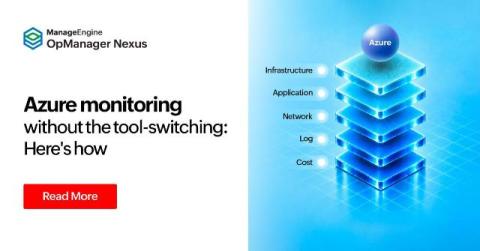
Fragmented Azure visibility? One Azure monitoring tool that tracks every layer

Most Azure monitoring setups look the same: Azure Monitor for metrics, Application Insights for apps, Log Analytics for logs, a separate tool for network, and another for cost. Each works in isolation. None of them talk to each other when something breaks. The Azure monitoring tool in ManageEngine OpManager Nexus consolidates infrastructure, application, network, log, and cost visibility data into a single console.

The human we find in our machines

There is a peculiar moment that happens when talking to AI. You ask it to rewrite an email, it does a good job, and you type, "Thanks!" Then, almost without thinking, you add, "Sorry, one more thing." It is software. It cannot be kept waiting, interrupted, or offended. Still, somehow, you have developed the manners. Then the questions get a little more personal.

The Cloud Repatriation Bill: What UK Businesses Didn't Budget for and How to Control Cost

Half of organisations spent more on public cloud than they had planned for last year. According to IDC research, reported by ITPro, 59% expect the same to happen again this year. That gap between what businesses expect to spend and what they actually spend is usually what starts the repatriation conversation. It is also where the next miscalculation begins.

S/4HANA Migration Monitoring: A Practitioner's Guide

Effective S/4HANA migration monitoring closes the operational gaps that quietly undo complex SAP transitions. Avantra eliminates the seams between phases where visibility typically disappears exactly when it matters most: the shift from baseline to cutover, the blind spot inside a parallel run, and the rushed handoff from legacy tools to Cloud ALM. This guide walks through every phase of migration monitoring in order, with a checklist you can adapt to your own project.

Meet Ada - AI Assistant: Ask the Question, Approve the Change

Ask any operations team what question comes up most, and it isn’t about alert routing or escalation logic. It’s the one typed into a channel a dozen times a day: who’s on call for this right now? It’s also one of the slowest questions to answer. The schedule is set up correctly, the overrides are in place, and the group’s ownership is right.

Vulnerability Fatigue: When Discovery Outpaces Remediation Capacity

Recent findings from Anthropic’s Project Glasswing offer a useful indication of where vulnerability discovery may be heading. Anthropic reported that it and its partners had used Claude Mythos Preview to identify more than 10,000 high- or critical-severity vulnerabilities across the software they reviewed. More significantly, Anthropic reported that the bottleneck had shifted from finding vulnerabilities to having the capacity to verify, disclose, and patch them.

Your AI coding gains are stuck before the code is even written

At some point this year, you likely approved a request to expand AI coding tool access across the team. The pitch was straightforward: engineers write code faster, the team ships more, the investment pays for itself. The first half happened. Engineers are writing code faster. If you're now being asked whether the investment paid off, and you're finding the honest answer is more complicated than a yes, you are not alone, and you have not been sold something broken.

Your users already know what's relevant. Are you listening?

TL;DR If you work on search relevance, you know the feeling. You ship a synonym. You boost a field. You add a vector model. You stare at a judgment set that was labeled six months ago and hope the next NDCG number moves in the right direction. Somewhere between offline metrics and production traffic, a quiet gap opens: you optimized for what you think users want, not for what they actually do when the results appear. That gap is not a failure of effort. It is a missing feedback loop.