Operations | Monitoring | ITSM | DevOps | Cloud

Honeycomb Raises $20M to Define the Future of Observability

I’m delighted to announce that Honeycomb has raised $20M in Series B funding, led by e.ventures Growth, with participation from existing investors Scale Venture Partners, Storm Ventures, Next World Capital, and Merian Ventures, and joined by Industry Ventures. Honeycomb has led the conversation and momentum behind observability for years, and now we’re poised to scale the product, community, and practice even further.

Introducing Elastic License v2, simplified and more permissive; SSPL remains an option

When we announced our license change for Elasticsearch and Kibana, moving the Apache 2.0-licensed source code to be dual licensed under both the Elastic License and SSPL, we also mentioned we would work closely with the community on a simplified and more permissive version of the Elastic License. I am happy to share the results with you. The Elastic License is already widely used.

Automatically debug and test CI/CD Pipeline with Dashbird

In this article, we will build a CI/CD pipeline with the AWS Cloud Development Kit (CDK) and debug a test it using Dashbird’s observability tool. In 2021, continuous integration and continuous delivery, or short CI/CD, should be part of every modern software development process. It helps deliver new features and bug fixes much faster.

AWS Distro for OpenTelemetry - Now with Splunk Observability Support!

Back in October, we announced the Splunk OpenTelemetry Collector Distribution, which offered the industry’s first production-ready support for OpenTelemetry. This distribution is the recommended way that customers of Splunk’s award-winning observability products capture metrics and traces.

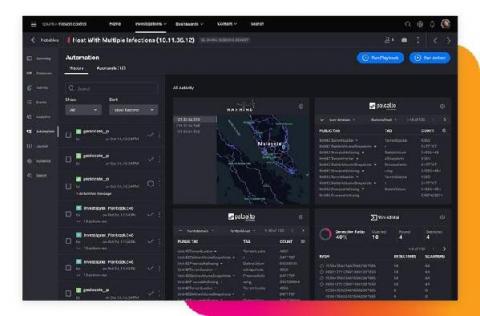
Next Level Automation: What's New with Splunk Phantom

Splunk Phantom 4.10 introduced many new enhancements, including the ability to develop playbooks in Python 3. In fact, Python 3 is now the default for Splunk Phantom playbooks. In doing so, we needed to create two different “playbook runners” to ensure we could continue to support playbooks written in Python 2.7 while also supporting Python 3.

Visual Link Analysis with Splunk: Part 2 - The Visual Part

In part one of the "Visual Analysis with Splunk" blog series, "Visual Link Analysis with Splunk: Part 1 - Data Reduction," we covered how to take a large data set and convert it to only linked data in Splunk Enterprise. Now let’s look at how we can start visualizing the data we found that contains links. Why, you may ask, when we just developed a nice table of data that shows us links? Tables of data don’t always work well if you have more than one page of data.

Incident Communication Is a Key Part of Resolving Network Issues

You’ve just received a notification—a major network issue has occurred. Hoping it’s a false positive, you complete an initial triage. Dang it! It’s the real thing. If you’re like me, your mind likely turns to one thing: fixing the issue as fast as you can. But hold on! Before you turn completely to fixing it, there’s another important aspect to any incident that you can’t forget, and that’s incident communication.

Automation & the Digital Workplace: The End of the IT Generalist

Everyone knows that automation is set to have a profound impact on the world of work in the coming years. Often called the ‘fourth industrial revolution,’ the impact is widely expected to be as profound as the industrial revolution itself. Just as mechanical systems replaced the works of human hands in the 19th century, artificial intelligence is expected to significantly supplant human brainpower in the 21st century, with equally profound impact on our personal and professional lives.