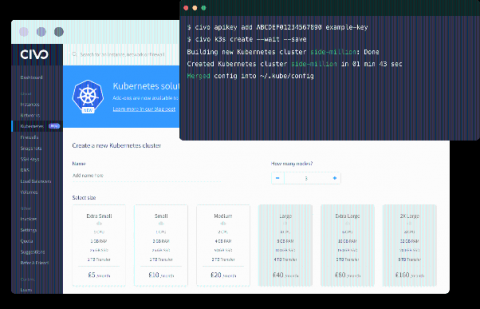
In today’s software-driven economy, every organization faces an imperative to modernize the way they deliver software in order to adapt and enable the digital era — or perish. Digital transformation across industries is driving the need for IT to enable Cloud-Native applications. This has led enterprises to adopt Kubernetes as the most effective way to support cloud-native architectures and to modernize their applications and IT infrastructure.
Docker is a powerful tool for creating and deploying applications. It simplifies rolling out applications across multiple systems and is a useful tool for integrating new technologies. An application that runs using Docker will start up the same every time on every system. This means that if the application works on your local computer, it’ll work anywhere that supports Docker. That’s great news! It simplifies your development process and can be a powerful tool for continuous delivery.
As Stephen Marsland once said, “if data had mass, the earth would be a black hole.” A vast part of the immense amount of structured and unstructured data that we call “Big Data” is nothing but machine-originated log data. Logs are generated for a lot of different purposes – from security to debugging and troubleshooting. They constitute a gold mine of useful information and actionable insights if properly stored, managed, and analyzed.
The growing threat of attacks and data breaches on IT systems has made security monitoring more crucial now than ever before. Organizations of all sizes face risks to their data, and without the proper tools in place, a single attack could pose a severe threat to your operations.
Hyper-V is a hardware virtualization platform used to create and run virtual machines on Windows host systems. Hyper-V allocates resources from the physical hosts it runs on to the virtual machines it creates. If those resources are spread too thin, virtual machines may encounter slow performance and startup failures. With our new integration you can monitor the health of every layer of your Hyper-V stack: physical hosts, virtual machines, and all of the applications and services running on them.
While Logz.io provides Kibana — the ELK Stack’s visualization tool — as part of its service, a lot of users have asked us to support Grafana. One of the leading open source visualization tools today, Grafana has some added value when compared to Kibana, especially around visualizing time-series data.
Each year we eagerly await the publication of the RightScale (now Flexera) State of the Cloud report to see which technologies and players are trending in the cloud ecosystem. In this year’s report (2019) one of the interesting takeaways is that in 2018 public cloud spending grew three times faster than private cloud and companies intend to spend almost 25% more on public cloud in 2019 than they did in 2018.
A very useful feature of Grafana is the ability to display dashboards and playlists on a large TV. Documentation on how to do this is sparse, which inspired this tutorial and also led to automating the process.
I’m on the og-aws Slack group, one of the more active groups of AWS developers and cloud practitioners. A member of the channel, Samuell, asked a question about S3, Cloudfront, and new files, and I saw the perfect opportunity to help out, so I offered.