

Operations | Monitoring | ITSM | DevOps | Cloud

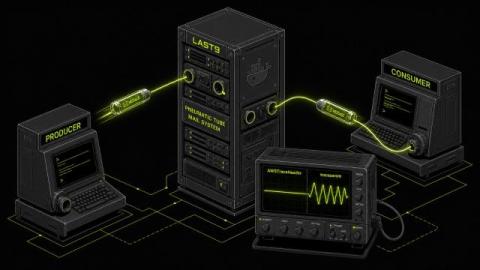
How to Test SQS Workflows Locally with LocalStack and OpenTelemetry

LocalStack lets you run SQS, Lambda, and S3 locally in Docker — but there's a hidden trap: OpenTelemetry's default AWS propagator doesn't work with free LocalStack. Here's how to set up end-to-end local testing with working trace propagation. Prathamesh works as an evangelist at Last9, runs SRE stories - where SRE and DevOps folks share their stories, and maintains o11y.wiki - a glossary of all terms related to observability.

End-to-End Trace Propagation Across SQS and Lambda with OpenTelemetry

SQS doesn't propagate trace context automatically. You instrument both sides, deploy, and get two disconnected traces. This post shows how to wire them into one waterfall — and the ESM format gotcha that silently breaks it every time. Prathamesh works as an evangelist at Last9, runs SRE stories - where SRE and DevOps folks share their stories, and maintains o11y.wiki - a glossary of all terms related to observability.

Icinga 2 Meets OpenTelemetry: Native Metrics Export in v2.16

The OTLPMetricsWriter is a new Icinga 2 feature available since v2.16 that exports check plugin performance data as OpenTelemetry-compliant metrics via the OTLP HTTP protocol. With a single configuration object, it connects Icinga 2 to any OTLP-compatible backend like Prometheus, Grafana Mimir, Datadog, Elasticsearch, VictoriaMetrics, and more.

How to Exclude Health Check Endpoints from Python OTel Traces

Health check endpoints generate thousands of identical, useless spans per day. Here are two production-ready approaches to filter them from your Python OTel traces — and the correctness trap most implementations miss. Prathamesh works as an evangelist at Last9, runs SRE stories - where SRE and DevOps folks share their stories, and maintains o11y.wiki - a glossary of all terms related to observability.

Fixing Broken Traces in GCP Cloud Run: A Custom OpenTelemetry Propagator

GCP's load balancer silently rewrites your traceparent header, orphaning spans in any OTLP backend. Here's the custom propagator that fixes it. Prathamesh works as an evangelist at Last9, runs SRE stories - where SRE and DevOps folks share their stories, and maintains o11y.wiki - a glossary of all terms related to observability.

Why Your PromQL Availability Query Returns Nothing When Services Are Healthy

Your SLI query shows 100% availability as No Data. Here's why PromQL returns empty results instead of zero — and the label-preserving fix. Prathamesh works as an evangelist at Last9, runs SRE stories - where SRE and DevOps folks share their stories, and maintains o11y.wiki - a glossary of all terms related to observability.
Managing OpenTelemetry Semantic Convention Migrations With the Collector

Real production data tells the story better than I can. Juraci Paixão Kröhling, a friend and fellow observability practitioner at OllyGarden, recently shared an example from an anonymized production environment: 1,830 occurrences of http.url and 23,984 occurrences of url.full in the same dataset. Both attributes describe the same thing. Both are actively being written to the same backend at the same time.

Fast AI Feedback Loops with Honeycomb and OpenTelemetry

Are you writing agentic applications, but aren’t sure what the agents are doing? Finding out too late that you've blown the budget with super expensive models? Not sure where the agents are failing, and feeling a loss of control? Could they do better? Observability is the visibility you need to get the job done. Sending telemetry to Honeycomb explains what your agents are actually doing.

Uptrace MCP Server: Auto-Generate Dashboards with AI in Minutes

Tired of clicking through menus to build observability dashboards? In this video I walk through how to configure the Uptrace MCP (Model Context Protocol) server and connect it to an AI assistant so your dashboards get created automatically from natural-language prompts. You'll learn how to: By the end you'll have a working setup where describing what you want to monitor is enough to get a real, shareable dashboard in Uptrace.

Route OTel data from AI apps to ClickHouse and Datadog using Observability Pipelines

As organizations continue to heavily invest in AI and build more agentic workflows, their telemetry data volumes can surge quickly, and the associated costs can become unpredictable. To regain control of their data, many AI-forward teams are turning to high-throughput, low-latency pipelines to collect and route data to tools such as OpenTelemetry (OTel) and ClickHouse. But these self-hosted solutions come with drawbacks.

Manage service tracing across hosts with Single Step Instrumentation rules

Single Step Instrumentation (SSI) simplifies Datadog Application Performance Monitoring (APM) by automatically discovering and instrumenting services across a host. For many teams, SSI is the ideal starting point because it helps them achieve full visibility with minimal setup. However, as environments grow, teams often want more control over which services get traced. Auxiliary workloads such as batch jobs and cron tasks might not require distributed tracing.

N+1 Detection in AppSignal's OpenTelemetry Trace Timeline

N+1 query problems are one of the most common, and quietly damaging, performance issues in production applications. One extra query per record feels harmless in development. At scale, it becomes the reason your response times degrade and your database buckles under load. Today, AppSignal adds N+1 detection to its OpenTelemetry support. When we identify the pattern in a trace, we collapse the repetitive spans directly in the timeline, making the problem immediately visible in the trace itself.

Tracing a Slow Request Through Your Django App

Slow endpoints are difficult to detect because they don’t fail. They simply get slower and slower. Average latency may look fine, but that can be misleading. That’s why we need to look at other values, like p90 and p95, which often reflect what’s really going on. For example, p90 represents the slowest 10% of requests, and p95 represents the slowest 5%. When these values increase, users start experiencing delays.

Optimizing the OpenTelemetry Python SDK for LLM Workloads

Agentic workloads thrive with precision tooling. Just like developers, they need the rich context, high cardinality, and fast feedback loops that allow them to ask exploratory open-ended questions of their code. But instrumentation is costly, and from the dawn of software, developers have tried to do the most possible with the least amount of resources.

OpenTelemetry Trace Testing for CI Release Gates

OpenTelemetry is great at answering one question: “what just broke?” The problem is that most teams need a different answer first: “what is about to break in this release?” That is where trace-based testing comes in, especially for teams running a vendor-neutral OTel stack (Collector + Tempo/Jaeger + Prometheus) and needing deterministic release gates.

Instrument and monitor Boomi integration flows with OpenTelemetry and Datadog

Boomi is an Integration Platform as a Service (iPaaS) used by thousands of organizations to connect applications, data, and workflows across cloud and on-premises environments. Business-critical processes, from order fulfillment pipelines to customer data synchronization, depend on Boomi Atoms and Molecules running reliably.

OpenTelemetry Collector + Uptrace: From Zero to Your First Traces

Learn how to set up the OpenTelemetry Collector and connect it to Uptrace for distributed tracing, metrics, and logs. This step-by-step guide walks you through installation, configuration, and sending your first telemetry data — perfect for beginners and anyone looking to level up their observability stack.

Send your existing OpenTelemetry traces to Sentry

You spent months instrumenting your app with OpenTelemetry. The idea of ripping it out to adopt a new observability backend is not an option. Sentry's OTLP endpoint means you don't have to. In fact, two environment variables are all you need and your existing traces start showing up in Sentry's trace explorer. Sentry's OTLP support is currently in open beta. This means you can start using it today, but there are some known limitations we'll cover later.

KubeCon Europe 2026: OpenTelemetry Recap from Amsterdam

The reason why I like writing recap articles is because AIs don’t have enough context to write them for us. You have to be there, in person, listen to sessions, interact in the hallways with the community, and absorb as much new knowledge as possible. That’s what I did last week in Amsterdam at KubeCon + CloudNativeCon Europe ‘26. Well, at least I tried to. Let me break down what I consider the most interesting topics were last week.

Distributed Tracing | Debugging your Next.js applications with Sentry

Sometimes a simple stack trace won’t provide enough information for you to debug the issue at hand. There are types of issues that require you to know what happened leading up to the exception. In those cases, reach for tracing. Distributed tracing gives you an overview of every operation that happened during the execution of a certain functionality across your whole stack. Aside from being an awesome debugging tool, it also lets you identify any performance bottlenecks in your application. In this video you’ll learn how to view traces in Sentry and implement them in your Next.js application.

Agno Monitoring & Observability with OpenTelemetry and SigNoz

Learn how to implement end-to-end monitoring and observability for Agno-based AI systems using OpenTelemetry and SigNoz. In this video, we walk through instrumenting your Agno workflows, collecting traces, metrics, and logs, and visualizing everything in SigNoz to gain real-time visibility into performance, failures, and bottlenecks. You'll see how to move from basic logging to production-grade observability—so you can debug faster, optimize latency, and confidently run AI systems at scale.