The latest News and Information on Distributed Tracing and related technologies.
Today, AWS announced enhancements for AWS Distro for OpenTelemetry. We’re working with AWS to build in additional support from partners. In tandem with that launch, Honeycomb is announcing support for event ingestion using OpenTelemetry Protocol (OTLP). With that change, you can simplify management overhead and configuration by no longer needing to maintain a separate OpenTelemetry exporter.
There is more to Distributed Tracing with Jaeger than just capturing machine data as with metrics, or tailing log files. To start, you should read this primer. In this article, I will walk you through the initial principles you’ll need before executing anything within your codebase. This is going to focus on Node.js, as slight differences and concerns exist for browser applications.
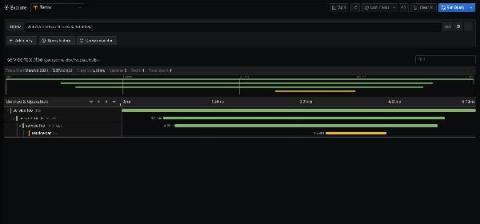
Grafana Tempo, the recently announced distributed tracing backend, relies on integrations with other data sources for trace discovery. Tempo’s job is to store massive amounts of traces, place them in object storage, and retrieve them by ID. Logs and other data sources allow users to quickly and more powerfully jump directly to traces than ever before. Previously we investigated discovering traces with Loki and exemplars.
This post aims to provide a very simple beginner’s guide to Jaeger + OpenTracing instrumentation for Go applications (the terms “application” and “service” is used interchangeably in this document) via a working example. If you are new to instrumentation, I recommend that you first read this post for a practical introduction to instrumentation for Jaeger and OpenTracing. You can also get more info on using logs in Go.
Every journey in distributed tracing starts with instrumenting an application to emit or extract trace data from each service as they execute. There are many ways to instrument, including the use of SDKs and pre-configured frameworks, and many protocols for transmitting the trace data to the analysis tool.
We’ve released support for tracing header interoperability in all of our Beelines. This means you can now mix and match distributed services instrumented with Beelines or with OpenTelemetry, and your traces will be preserved in Honeycomb!