Your senior leadership started stressing out about data breaches. It’s not that they haven’t worried before, but they’ve also started looking at the rising tide of data breach awareness. Specifically, they’re starting to see more new security and privacy laws passed at the state and federal levels. Now, you’ve been tasked with the very unenviable job of choosing a compliance framework, and you’re looking at the Center for Internet Security (CIS) Controls.
Financial services firms face three key network issues: maintaining compliance with an array of regulations, keeping a growing horde of financial data hungry hackers at bay, and earning the trust of users with an always-on responsive network. Financial data is so valuable, cybercriminals make getting it a top priority. And financial services networks are so interconnected and complex, there are all sorts of ways hackers can try to break in. The security threat to finance is more than bad.
It’s that time of the year again. The annual and dreaded IT and security audit is ramping up. You just received the documentation list and need to pull everything together. You have too much real work to do, but you need to prove your compliance posture to this outsider. Using log management for compliance monitoring and documentation can make audits less stressful and time-consuming.
According to ABC News, there has been a 600% rise in security intrusions during the COVID-19 pandemic, which is expected to double before 2025. In many circumstances, admins and technicians either intentionally or unintentionally play a part in the process of derailing the organization’s strategy for success. In order to prevent such mishaps, MSPs need a recovery plan to recuperate from any unfortunate accidents or cyberattacks.
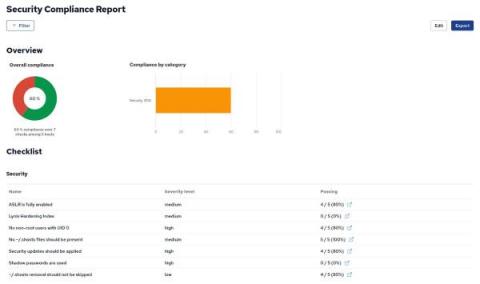
The CIS benchmark has hundreds of configuration recommendations, so hardening and auditing a Linux system manually can be very tedious. Every administrator of systems that need to comply with that benchmark would wish that this process is easily usable and automatable. Why is that? Manual configuration of such a large number of rules leads to mistakes – mistakes that cause not only functional problems, but may also cause security breaches.
January 17th: London, UK – Canonical, the company behind Ubuntu, the world’s most popular operating system across private and public clouds, now offers the Ubuntu Security Guide tooling for compliance with the DISA Security Technical Implementation Guide (STIG) in Ubuntu 20.04 LTS. The new automated tooling builds on Canonical’s track record of designing Ubuntu for high security and regulated workloads, powering U.S. government agencies, prime contractors, and service providers.