Operations | Monitoring | ITSM | DevOps | Cloud

Un-observable AI is Un-trustworthy AI

Recently, someone talked Chipotle’s customer support agent into reversing a linked list – a task completely unrelated to burritos in any way. Screenshots circulated, people laughed, but underneath the joke sat a sharper question. If a production support agent will do that on a public channel, what else will it do that nobody is screenshotting? The bug is funny. The trust gap behind it is not.

Deep AI Investigation for ITOps: What It Is and Why It Matters

Investigation is the most time-consuming and cognitively demanding phase of incident response, and it’s the phase least served by existing tooling. Modern ITOps teams have spent years investing in better detection and alerting. The tools are faster, the dashboards are richer, and anomaly detection keeps improving.

Use This OTel Processor to Prevent Your Dashboards From Breaking

A semantic-convention rename (http.method → http.request.method) can silently break your RED metrics — no errors, just gaps in dashboards and alerts. The OpenTelemetry Collector's schema processor fixes it: put it first in your pipeline and it normalizes attribute names no matter what each service emits. Migration mode writes BOTH the old and new names, so you get zero-downtime upgrades while queries keep working.

Eight best practices for a successful cloud migration strategy

Moving to the cloud is one of the most consequential decisions an IT organization makes. A successful cloud migration strategy sets the foundation for how your business scales, innovates, and competes. But too often, cloud migration initiatives stall, underperform, or force organizations to repatriate applications back on-premises because the groundwork wasn’t laid correctly.

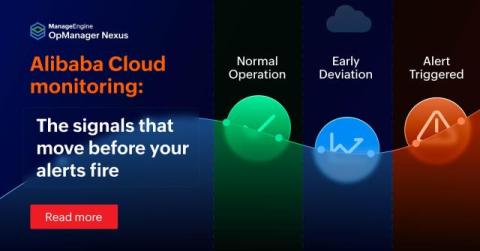
Alibaba Cloud monitoring: What changes when scale, speed, and cost collide

Alibaba Cloud monitoring isn't AWS or Azure monitoring with a different logo. The way its services scale, absorb load, and send early warning signals follows its own logic and if you're watching the wrong things, you'll find out too late. Cloud monitoring conversations often follow patterns set by AWS and Azure. The metrics are familiar, dashboards look the same, and operational playbooks are built around expected infrastructure behavior.

Troubleshooting website connection failures with website monitoring RCA

Every engineer has a story about the outage that came out of nowhere. One moment everything is green. The next, your monitoring dashboard lights up red, your inbox fills faster than you can read it, and somewhere a customer is staring at a blank screen wondering if your business still exists.

Troubleshooting website response time latency

Your dashboards may be telling a different story than what the customers are experiencing There's a version of a website problem that nobody talks about enough—the one where everything is technically fine. The site is up. The server is responding. No alerts have fired. And yet, somewhere out there, a user is watching a spinner rotate for the fifth second in a row, quietly losing faith in your product. This is what makes response time latency the most deceptive problem in web operations.

The Miasma worm explained: How it Hit Red Hat and Microsoft

Miasma has already hit Red Hat and 73 Microsoft GitHub repos. Here's how it works and what your team can do right now. Nigel Douglas, Head of Developer Relations at Cloudsmith, breaks down the Miasma worm – a self-replicating supply chain attack and evolved variant of Mini Shai-Hulud from threat group TeamPCP. Learn how Miasma uses the yo-yo attack method to move laterally across registries and workstations, why conventional scanners missed it, and the practical steps security teams can take today, including cooldown policies and continuous risk assessment.