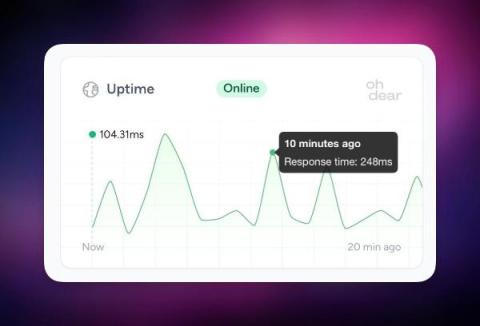
Today, we released the ohdearapp/ohdear-pulse package, which contains Laravel Pulse cards to show you the status of your scheduled jobs, any broken links you have in your Laravel app, and uptime / HTTP performance stats. All of these cards use the Oh Dear API to fetch their data. Laravel Pulse is a first party package that can display a dashboard with information surrounding usage and performance of your Laravel app. Here’s how a default installation looks like.
A PHP application might produce many different levels of warnings and errors during its execution. Seeing these errors is crucial for developers when troubleshooting a misbehaving application. However, many developers often encounter difficulties displaying errors in their PHP applications, leading to silent app failures.
PHP is fast but it's performance can suffer when it's overwhelmed by I/O operations such as making a request to an external API or handling file uploads. In this article, you'll learn how to create asynchronous PHP applications using ReactPHP to solve this problem.
PHP is a powerful language used by at least 80% of all the applications you use today as their backend scripting language. This can be attributed to its relatively simpler syntax, which is on the same line as other C-style languages. It supports different operating systems (Windows, Linux, macOS), web servers, databases and integrates seamlessly with popular databases like MySQL, PostgreSQL, and Oracle, making it a suitable choice for database-driven applications.
In my last blogpost I explained how our ipl-html lib works and how to use it. With the help of ipl-html it is possible to add forms. Usually we want to validate the data of the form before submitting it and display messages if the validation fails. For this purpose, we have introduced the ipl-validator. The ipl-validator includes many useful validators, and today I want to explain how you can easily use them.
If you are a Symfony PHP developer, you will need Symfony monitoring. With the ever-increasing need for web applications to perform at their best, developers require full visibility and observability. This way, they have full control of the performance and its maintenance. Imagine you have created an application. You have deployed it but do not know how it works. This is where an Application Performance Monitoring tool is of great use. It should be on every developer’s toolkit.