Operations | Monitoring | ITSM | DevOps | Cloud

Azure SQL Database monitoring

Azure Database is a comprehensive cloud-based service Microsoft offers as part of its Azure cloud computing platform. It provides various database solutions to cater to different application needs, offering scalability, reliability, and performance. Here’s a quick look at Azure Database: Database Types: Azure Database supports various databases, including SQL databases, NoSQL databases, and data warehousing solutions.
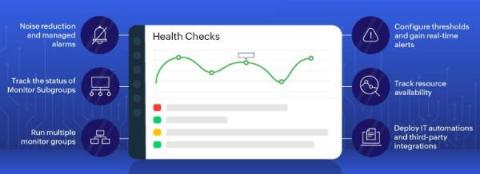
6 ways to isolate performance issues in your monitors with Site24x7 Health Checks

Is it only us, or have you also felt that you cannot do much with just Monitor Group (MG)? If the feeling is mutual, we are on the same page. Your ops engineer might have felt that MG restricts the ability to perform IT automation. For an ops engineer, how easy it is to handle incidents depends on how frequently MG status alarms are received. Enter Site24x7 Health Checks.

10 Best Internal Developer Portals to Consider in 2023

In a world characterized by complex software and fast-paced development cycles, Internal Developer Portals have become increasingly vital. Unlike Internal Developer Platforms, which are more focused on the code-to-cloud deployment pipeline, an Internal Developer Portal acts as a centralized hub for a multitude of resources, tools, and APIs that developers require throughout the software development lifecycle.

Your Secret Weapon Against Cyber Threats: Enhancing Cyber Resiliency With Cribl

In a previous webinar, we discussed the importance of ensuring that your enterprise is cyber resilient and the politics around establishing a thriving cybersecurity practice within your organization. This week’s discussion covers specific tactics and solutions you can implement when you begin this initiative — watch the full webinar replay to learn more about how Cribl supports your cyber resiliency efforts.

AI adoption for software: a guide to learning, tool selection, and delivery

This post was written with valuable contributions from Michael Webster, Kira Muhlbauer, Tim Cheung, and Ryan Hamilton. Remember the advent of the internet in the 90s? Mobile in the 2010s? Both seemed overhyped at the start, yet in each case, fast-moving, smart teams were able to take these new technologies at their nascent stage and experiment to transform their businesses. This is the moment we’re in with artificial intelligence. The technology is here.

Heroku Monitoring: What To Look For In Your Addons

Heroku is a cloud-based platform that supports multiple programming languages. It functions as a Platform as a Service (PaaS), allowing developers to effortlessly create, deploy, and administer cloud-based applications. With its compatibility with languages like Java, Node.js, Scala, Clojure, Python, PHP, and Go, Heroku has become the preferred choice for developers who desire powerful and adaptable cloud capabilities.

What is Shadow IT? Will AI make this more challenging?

Shadow IT is a term used to describe IT systems, applications, or services that are used within an organization without the explicit approval, knowledge, or oversight of the IT department or the organization’s management. It typically arises when employees or departments adopt and use software, hardware, or cloud services for their specific needs without going through the official IT procurement or security processes.

Better anomaly detection in system observability and performance testing with Grafana k6

Grzegorz Piechnik is a performance engineer who runs his own blog, creates YouTube videos, and develops open source tools. He is also a k6 Champion. You can follow him here. From the beginning of my career in IT, I was taught to automate every repeatable aspect of my work. When it came to performance testing and system observability, there was always one thing that bothered me: the lack of automation. When I entered projects, I encountered either technological barriers or budgetary constraints.

How to monitor SLOs with Grafana, Grafana Loki, Prometheus, and Pyrra: Inside the Daimler Truck observability stack

In order for fleet managers at Daimler Truck to manage the day-to-day operations of their vast connected vehicles service, they use tb.lx, a digital product studio that delivers near real-time data along with valuable insights for their networks of trucks and buses around the world. Each connected vehicle utilizes the cTP, an installed piece of technology that generates a small mountain of telemetry data, including speed, GPS position, acceleration values, braking force and more.