Operations | Monitoring | ITSM | DevOps | Cloud

New State of DevOps Report 2022: Broadcom Sponsors Key Research

For DevOps teams looking for insights on how to improve, it’s invaluable to leverage the learnings of others. At the same time, given the wide range of DevOps teams’ expertise, tenure, and organizational dynamics, it’s also clear that one size does not fit all. That’s why efforts like this year’s “Accelerate State of DevOps Report” are so important. We’re proud to be a sponsor of this 2022 edition.


Effective Log Management and Analysis as an Enabler for Observability

Traditionally, when monitoring or troubleshooting active incidents, engineers access logs directly on the source system. However, modern IT environments are now too complex, and engineers can no longer manage and analyze logs effectively this way. With the adoption of microservices and the use of cloud-native infrastructure, it’s no longer feasible.

Anodot Named Momentum Leader on G2's Fall Grid

We are proud to announce that Anodot has been named Momentum Leader on G2’s fall grid for Cloud Cost Management Software. G2 is the largest and most trusted software marketplace. More than 60 million people annually use G2 to make smarter software decisions based on authentic peer reviews. G2 is disrupting the traditional analyst model and building trust by showcasing the authentic voice of millions of software buyers.

Optimize Your Infrastructure Resources for Continuity of Network Monitoring Operations

Leverage DX NetOps network monitoring software metric projections to manage demands for IT resources proactively and cost-effectively. Capacity is a finite resource, so your IT Team needs to carefully analyze current and future use case scenarios to prevent potential bottlenecks. Presenting key network metric projections in a simple and unified manner is paramount to predict capacity and to understand when more resources are needed, allowing you to plan accordingly.

How to add a store locator to your ecommerce storefront with Elastic

One thing that adds value to a business’s ecommerce presence is the ability for customers to easily find physical stores with an interactive map. Store locators can be built quite rapidly — all you need to place them on a map is geographic location in latitude and longitude. In this post, I’ll outline the pieces needed to put together a proof-of-concept store locator that could later be added to an ecommerce website.

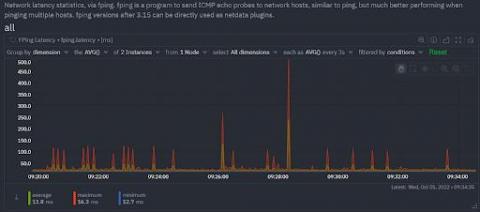
How to monitor host reachability

Most sysadmins and developers have at some point used a few of the popular Linux networking commands or their Windows equivalents to answer the common questions of host reachability- that is, whether a host or service is reachable and how fast it responds. One of the simplest, common checks, is to simply ping a host to verify that it’s reachable from where you issue the command, and to see the total time it takes for the host to receive your request.

A Guide To Opentelemetry Collector

This article will give you a quick overview of some of the key attributes you should know in order to get started with leveraging the OpenTelemetry collector for your next telemetry project. As an integral component of any project that involves distributed tracking, the OpenTelemetry Collector plays an important role. Simply put, it is helpful to know that the collector itself is a data pipeline service that collects telemetry data.

What is Observability: A Beginner's Guide

Observability is a methodology that you incorporate into your enterprise architecture to provide greater visibility into what is happening. It helps us determine the states of the system from their external outputs and allows technicians to identify bottlenecks, predict issues and mitigate them. As the architectures of IT systems are becoming more complex and distributed we use observability to meet the need to measure their internal states.

New Honeycomb Integration With ServiceNow

Today, I’d like to tell you about a new community-contributed integration that connects Honeycomb to your ServiceNow workflows. My new integration reimagines what’s possible when connecting observability tools with ITSM systems. This post explains how it works and how to get started with it.