Operations | Monitoring | ITSM | DevOps | Cloud

Top Root Cause Analysis Tools Built for Runtime Context

Root cause analysis tools are designed to help engineering teams understand why failures happen in production and other remote environments. As modern systems become more distributed and input-dependent, many incidents cannot be reproduced outside live environments. The stakes are significant: high-impact IT outages cost organizations a median of $2 million per hour, with annual downtime costs reaching $76 million per organization.

From Observability to Action: How Product Analytics Is Closing the Loop in Modern Operations

Over the past decade, observability has become a cornerstone of modern operations. Metrics, logs, and traces have given teams unprecedented visibility into how systems behave under real-world conditions. Infrastructure can be monitored in real time, incidents can be detected faster, and performance bottlenecks can be diagnosed with increasing precision. But for all its progress, observability still leaves an important question unanswered.

Leveraging Cognitive Diversity to Tackle System Complexity

Most engineering leaders today understand that diversity matters. They've built teams that reflect a range of backgrounds, functions, and experience levels. They run postmortems, retrospectives, and architecture reviews that bring multiple voices to the table. They believe, not unreasonably, that this variety of perspectives leads to better decisions. But there's a problem hiding inside that assumption that can undermine everything: who people are is a surprisingly poor predictor of how they think.

How OpenRouter and Grafana Cloud bring observability to LLM-powered applications

Chris Watts is Head of Enterprise Engineering at OpenRouter, building infrastructure for AI applications. Previously at Amazon and a startup founder. As large language models become core infrastructure for more and more applications, teams are discovering a familiar challenge in a new context: you can't improve what you can't see.

Making encrypted Java traffic observable with eBPF

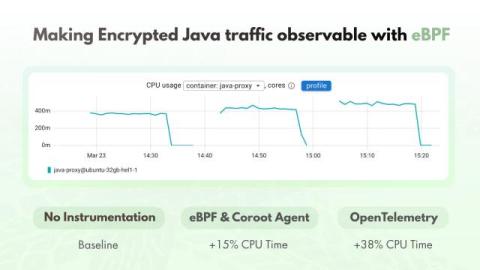
Coroot's node agent uses eBPF to capture network traffic at the kernel level. It hooks into syscalls like read and write, reads the first bytes of each payload, and detects the protocol: HTTP, MySQL, PostgreSQL, Redis, Kafka, and others. This works for any language and any framework without touching application code. For encrypted traffic, we attach eBPF uprobes to TLS library functions like SSL_write and SSL_read in OpenSSL, crypto/tls in Go, and rustls in Rust.

Claude Code + Lightrun MCP: Your AI Agent Now Has Live Runtime Vision

Claude Code, Anthropic’s coding agent, now integrates with Lightrun through MCP. AI code assistants have been flying blind. Google Dora’ 2025 report found it is causing, an almost 10% increase in code instability. Even with up to 1M tokens of context available in Claude, this powerful agenti cannot see how the code it writes actually behaves inside a live system under real traffic, real dependencies, and under a load of 10,000 requests per second.

How agentic ITOps overcomes observability tool gaps

As enterprise ITOps teams monitor increasingly complex, cloud-based, containerized systems, traditional observability practices are struggling to keep up. As IT infrastructure complexity increases, the typical response is to layer on more monitoring, logging, and instrumentation.

Production Is Where the Rigor Goes

In early February, Martin Fowler and the good folks at Thoughtworks sponsored a small, invite-only unconference in Deer Valley, Utah—birthplace of the Agile Manifesto—to talk about how software engineering is changing in the AI-native era. They recently published a summary of key insights and themes from the summit, sorted into ten topical buckets.

AI in observability in 2026: Huge potential, lingering concerns

The role of AI in observability is evolving rapidly, but the data from our fourth annual Observability Survey makes one thing abundantly clear: the potential is real, and so are the reservations. Practitioners overwhelmingly see value in using AI to help surface anomalies, forecast and spot trends, assist with root cause analysis, and get new users up to speed quicker.

Open standards in 2026: The backbone of modern observability

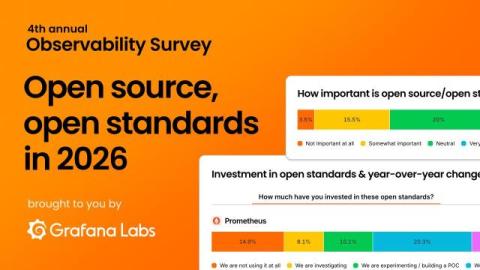
Open source software and open standards are now an essential part of how organizations maintain their systems. That's not to say they haven't always been important, but the fourth annual Observability Survey, brought to you by Grafana Labs, shows just how deeply the shift to open has taken hold, with 77% of respondents saying open source and open standards are important1 to their observability strategy.