Operations | Monitoring | ITSM | DevOps | Cloud

ICYMI: Achieving Visibility in Your CI/CD Pipeline With Honeycomb + CircleCI

Before continuous integration came to be, setting up builds was no fun because the complexity and overhead involved in a release cycle was compounded by inflexible, manual processes. The release cycle was slow and often resulted in breaking changes. Continuous integration and continuous delivery (CI/CD) has changed much of that through pipelines that automate how we build and test software—today, we can deploy, have builds fail, and resolve any errors faster than ever.
New Research: The State of Cloud-Driven Transformation

Over the last couple years, cloud transformation has become increasingly critical, evolving from a preferable priority to an urgent imperative. In our rapidly changing world, organizations have had to innovate at unprecedented rates — and those most successful are harnessing the power of cloud to move faster and smarter. But it’s more than a simple migration.

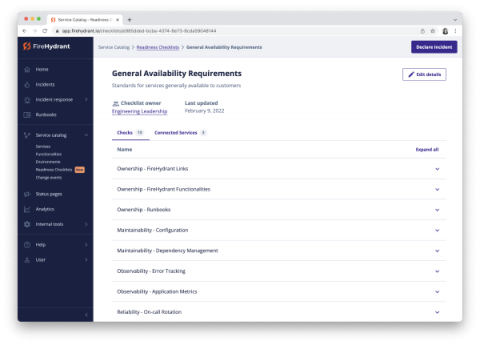
It's not ready for production until it has an Operational Readiness Checklist

Maintaining the reliability of complex services just got easier with Operational Readiness Checklists. Service owners and engineering leaders can now evaluate and maintain the production readiness of the services their users rely on every day: spot risks in your service dependencies before they cause incidents, and respond quickly if they do. Before you put a new service into production, readiness checklists help you dot-your-is and cross-your-ts.

Low latency Linux kernel for industrial embedded systems - Part II

Welcome to Part II of this three-part blog series on adopting the low latency Ubuntu kernel for your embedded systems. In case you missed it, check out Part I for a brief intro on preemptable processes in multiuser systems and memory split into kernel and user space. The low-latency Ubuntu kernel ships with a 1000 Hz tick timer granularity (CONFIG_HZ_1000) and the maximum preemption (CONFIG_PREEMPT) available in the mainline Linux kernel.

Canonical: a world leader in remote first working

Over the last two years much of the Global workforce has experienced remote working first-hand. Sound familiar? For many, this was a ‘career first’, changing their views on the effectiveness of remote working. The desire to be office based has reduced dramatically with people wanting to avoid time-consuming commutes. In a recent survey, a staggering 91% of US workers wanted home working to persist post pandemic.

Change Enablement vs. Change Management: What's the Difference?

Change is the only constant, particularly in a rapidly evolving industry like IT. Software gets constant updates, new hardware gets launched, and frameworks evolve with trends. Staying up-to-date on these changes can help you stay ahead of the competition. But it's not always easy to get people used to these new changes. It’s no surprise that change management has been a key aspect of ITIL.

Traceroute software-the troubleshooting tool your network needs

The need for in-depth network monitoring is growing exponentially as organizations expand in size and more companies are established. Increased monitoring needs demand a feature-rich tool to simplify networks and get a clear view of their underlying infrastructure. Diagnosing network faults and ensuring a well-balanced operation of all network devices is the primary task of a network admin any day.

Expert believes machine learning can improve after failing for Covid

Machine learning and artificial intelligence (AI) systems have long been touted as the future of medicine. A patient can walk into a doctors office, and after a quick scan discover their risk for a variety of diseases, and be given information on how to prevent them from occurring. Patients suffering from diseases like cancer can have treatment decisions made by an AI that can optimize care and maximize likelihood of survival.

Serverless vs Fully Managed Services: What Are They? What is the Difference Between Them?

One of the first questions you must ask yourself when deciding to construct an application in the cloud is whether your application will be built utilizing serverless or fully managed services. To begin, let me state that these are extremely loosely defined concepts and that there may be cloud services that fall somewhere in the middle, as well as others that are both serverless and fully managed services at the same time.