Operations | Monitoring | ITSM | DevOps | Cloud

AI Summary Agent in Turbo360

Handed over an Azure integration environment you've never seen before? Turbo360's AI Resource Summary agent gives any support operator or engineer an instant plain-English overview of what a resource is, how it behaves, and what to watch out for - without needing to ask the developers. In this demo: Great for: IT operations teams, MSP NOCs, cloud support engineers, and anyone responsible for running integration workloads they didn't build.

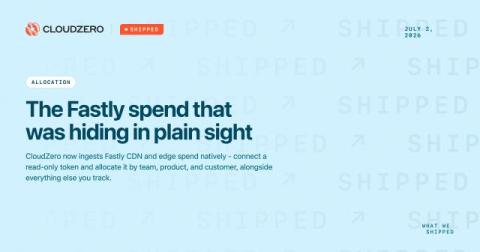
Shipped: The Fastly spend that was hiding in plain sight

CDN and edge spend is easy to lose track of. Fastly bills on its own, off to the side of your cloud invoice – real money, often significant, sitting where none of your cost tooling reaches. So it stays its own island: a lump sum with no easy way to tie it back to the teams, products, and customers driving the traffic.

OpenAI API cost calculator: estimate your GPT spend before it estimates you

This OpenAI API cost calculator (also an AI inference calculator for o3/o4-mini thinking tokens) estimates your monthly OpenAI API pricing bill from three inputs: model, request volume, and average tokens per request. Toggle between standard, batch, and cached pricing and get your number in seconds. It also shows what the same workload costs on Claude and Gemini. For the full per-model rate card, see CloudZero's OpenAI API pricing guide.

VDI Monitoring: How to Ensure High-Performance Virtual Desktop Infrastructure

Remote and hybrid work turned virtual desktops from a niche IT choice into a core way employees get their jobs done. When a desktop lives in the data center or the cloud, every logon, click, and screen refresh depends on infrastructure the user never sees. That shift is why VDI monitoring matters: it protects the end-user experience when the desktop is no longer local. The challenge is that a single slow session can have dozens of causes—across compute, storage, network, and the broker layer.

Apache Kafka Share Groups are NOT true queues. Here's why that's a good thing.

This Spring, the Apache Kafka community released version 4.2 with a “production-ready” Share Group feature. Also known as a “Kafka queue” people were eager to see this feature because it introduced elastic consumer scaling, individual message acknowledgments, and built-in "poison pill" handling; similar to what you'd find in traditional message brokers like RabbitMQ and ActiveMQ.

Right Size Your Model Usage with Valkey and Semantic Routing

Benchmarks keep showing that picking the right LLM is hard. The easy answer is "just use the most powerful one." That works, but it is pricey. A small, cheap, or local model can handle many simple requests just as well as a frontier model, for a fraction of the cost. That is what semantic routing is for. Use middleware that looks at an incoming request and decides which model should answer it.

Cloud repatriation strategies: From public dependency to hybrid flexibility

The phrase "cloud first" dominated IT strategy for the better part of a decade. It was gospel, practically unchallengeable, and for a lot of organizations, it was the right call. But something shifted between 2024 and 2026, and it shifted fast. Bills stopped being defensible. Vendor pricing imploded. Sovereignty stopped being a compliance checkbox and became a procurement requirement.

To learn and improve, we cannot be afraid to fail

“Deployment stress doesn’t just come from high-profile public outages. It often starts much earlier, when a fear of failure seeps into team culture.” Rob Richardson, Software Craftsman Rob certainly knows the stress and embarrassment of public deployment failures. "But overall" he reflects, "I’ve had more stress in my career from internal failures.