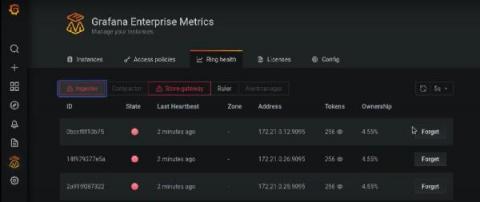
We built Grafana Enterprise Metrics (GEM) to empower centralized observability teams to provide a multi-tenanted, horizontally scalable Prometheus-as-a-Service experience for their end users. The GEM plugin for Grafana is a key piece of realizing this vision. It provides a point-and-click way for teams operating GEM to understand the state of their cluster and manage settings for each of the tenants within it.
In my previous blogs in the Dashboard Server Learning Path, we looked at working with the Web API tile and the PowerShell tile. In this instalment, let’s try the SQL tile. This tile will let you connect to any SQL database and run a SQL query straight from SquaredUp. This tile is also available in both the SquaredUp for SCOM and Azure products, so I have some familiarity with it already.
Kubernetes makes it easier in certain ways to manage reliability. But incident response teams and SREs must also be prepared to handle the unique reliability challenges that K8s creates.
Amazon Web Services has announced enhanced support for the open-source distribution of the OpenTelemetry project for its users. AWS Distro for OpenTelemetry (ADOT) now includes support for AWS Lambda layers for the most popular languages and additional partners integrated into the ADOT collector. And one of those partners is Logz.io! Logz.io is happy to announce that our exporter is now included in the AWS Distro for OpenTelemetry.
Finding the right information in Mattermost is critical to work smarter and be more productive. Searching in Mattermost now finds both relevant messages and files in your team’s conversation history. Search will return results for attachments that match the file name or contain matching text content within supported document types. File search is available today in Mattermost Cloud and in Mattermost Self-Managed v5.35 (available May 16), with mobile support coming soon.
We are thrilled to announce the availability of Calico Enterprise 3.5, which delivers deep observability across the entire Kubernetes stack, from application to networking layers (L3–L7). This release also includes data plane support for Windows and eBPF, in addition to the standard Linux data plane. These new capabilities are designed to automate, simplify and accelerate Kubernetes adoption and deployment. Here are highlights from the release…