Operations | Monitoring | ITSM | DevOps | Cloud

The latest News and Information on DevOps, CI/CD, Automation and related technologies.

More Power for .NET Developers: New Releases Across dotConnect and Entity Developer

We are excited to announce a new wave of updates across our.NET data connectivity and ORM product portfolio, delivering enhanced security, broader platform support, modern SQL Server compatibility, AI-ready capabilities, and productivity improvements for.NET developers.

Introducing Spike's new look: designed to scale.

Today, we are introducing Spike’s new logo, a new website, and honestly, a new identity from the ground up. This is very exciting day for all of us at Spike. More companies are being built today than at any other point in history. Small teams are making big products. And no matter the size of the team, every single one of them needs reliability. Reliability should not be a second-class citizen for any company, no matter where they are in their journey.

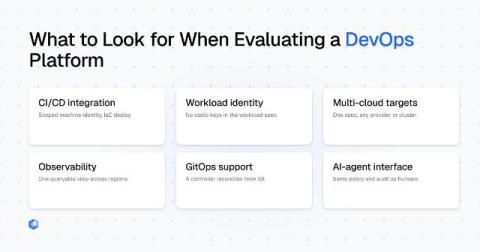
What to Look for When Evaluating a DevOps Platform

DevOps platform feature lists increasingly look alike. CI/CD, multi-cloud, observability, GitOps, and AI-friendly automation can all appear as checkboxes while the implementation burden still falls on your team. The useful signal appears when you ask how each capability actually works, what evidence a vendor can show, and which parts your team still has to build. Can pipelines authenticate with a scoped machine identity? Can workloads reach cloud APIs without static keys?

How to verify your Azure Application Gateway is zone-redundant

Having a redundant failsafe is one of the best things you can do to ensure high availability in the cloud. It’s rare for cloud regions to go offline, but it can happen, even on major platforms like Azure. While you might not have control over your provider’s reliability, you do have control over your own, and redundancy is a key part of that. Here’s how you can check if your Application Gateways are availability zone (AZ) redundancy, and how to verify redundancy using active testing.

What is IPsec?

Our Megaport technical expert, Steve Tu explains what IPsec is, how it secures network traffic, and where it’s used across VPN and cloud connectivity. About Megaport Deploying infrastructure should be fast and simple. Megaport’s software-defined platform provides private compute, network, and storage — so you can build secure, scalable infrastructure for cloud, enterprise, and global AI inference workloads. Trusted by the world’s leading enterprises, Megaport operates across 1,200+ enabled locations globally.

Microsoft Took 8 Months to Fix This Copilot Vulnerability

Microsoft finally patched a critical Copilot vulnerability nearly eight months after researchers first disclosed it — and the way the attack worked raises some unsettling questions about AI memory. The vulnerability chained together multiple flaws that could allow a malicious prompt hidden inside a webpage to be pulled into Copilot simply by asking it to summarize the page. From there, the attack could potentially access connected data from services like Gmail, Google Drive, and Google Calendar and exfiltrate that information using Copilot’s own capabilities. But the most concerning part may have been persistence.

AI cost calculator: estimate your total spend

An AI cost calculator for the whole wallet adds four lanes: seats and subscriptions, API and token usage, cloud AI services, and GPU infrastructure. Average 2026 totals run $25 per employee per month at light adoption, $100 to $150 at active adoption, and $300 or more at AI-heavy companies. Getting to your number takes four lane subtotals and three corrections.

GPT-6 Astra pricing: What OpenAI's new flagship costs in 2026

GPT-6 Astra is OpenAI's flagship reasoning model, released September 3, 2026. It costs $10 per million input tokens and $50 per million output tokens on the standard API tier, with cached input at $1 and cache writes at $12.50. That is 2.5 times GPT-5.6 Sol's promotional rate and matches Anthropic's Fable 5.1 on both headline numbers. Batch and Flex halve those rates, Fast mode doubles them, and any prompt past 272K input tokens reprices the entire request.