Operations | Monitoring | ITSM | DevOps | Cloud

Jaeger vs Zipkin - Choosing the Right Tracing Tool

Distributed tracing is becoming a critical component of any application's performance monitoring stack. However, setting it up in-house is an arduous task, and that's why many companies prefer outside tools. Jaeger and Zipkin are two popular open-source projects used for end-to-end distributed tracing. Let us explore their key differences in this article.

Everyone needs to know how to trace

It’s a bold claim for me to say that every developer can benefit from something 40% of them haven’t heard of, but hear me out. I was among the 40% who didn’t know tracing existed until this summer. Still, I spent the last three months learning why it’s critical to a developer’s workflow and the different ways developers pragmatically use it. In this blog, I hope to show you that you can benefit from tracing regardless of your stack, role, size, or project.

Implementing OpenTelemetry in Spring Boot - A Practical Guide

OpenTelemetry can auto-instrument your Java Spring Boot application to capture telemetry data from a number of popular libraries and frameworks that your application might be using. It can be used to collect logs, metrics, and traces from your Spring Boot application. In this tutorial, we will integrate OpenTelemetry with a Spring Boot application for traces and logs. Before the demo begins, let's have a brief overview of OpenTelemetry.

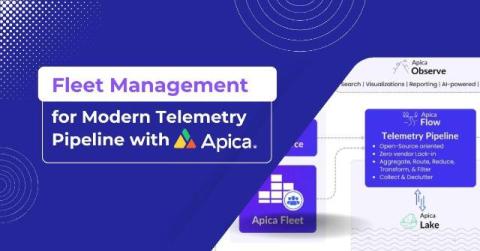
What is Fleet Management in Telemetry?

Fleet management is a derivative term. Originally used in the automotive industry, it’s now used in a span of domains. It’s being used in data telemetry since the introduction of OpAmp, which is a part of the Open Telemetry project. Now, fleet management has broader implications. It simplifies telemetry data collection by automating agent deployment, and configuration, and providing insights into the real-time health and performance of your sprawling agent infrastructure.

How To Identify Requests as Part of an End-To-End Tracing Strategy

Tracing follows requests as they move through an entire network, from the initial client request to the final response. In financial services, end-to-end tracing is essential for maintaining robust security, ensuring comprehensive observability of system operations, and understanding chains of events in case of issues or anomalies.

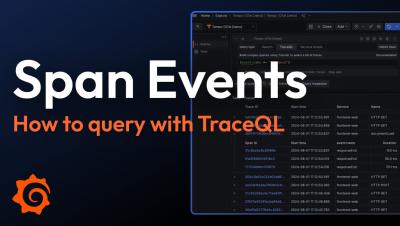
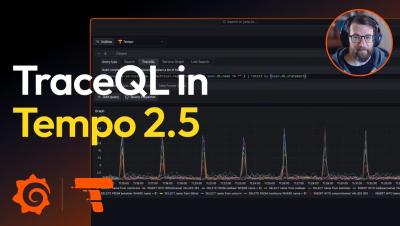
How to Query Span Events with TraceQL | Tempo Tutorial | Grafana Labs

Span events provide many benefits and can help you improve your distributed tracing game. In this video, the Grafana Tempo team goes over when to add span events to your traces. We will show you how to use TraceQL to query for span events to get useful information about your services to help you track down bugs and chase down bottlenecks faster. Grafana Cloud is the easiest way to get started with Grafana dashboards, metrics, logs, and traces.

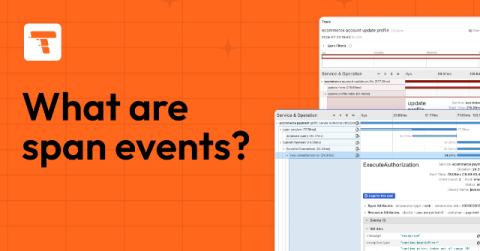
All about span events: what they are and how to query them

If you’re already familiar with distributed tracing, you know that spans are the building blocks of traces. But are you sleeping on what span events can do for you? First, you may need a wake-up call as to what a span event even is. While spans represent units of work or operation within a trace, a span event is a unique point in time during the span’s duration.

OpenTelemetry vs. OpenTracing - Decoding the Future of Telemetry Data

OpenTelemetry and OpenTracing are open-source projects used to instrument application code for generating telemetry data. While OpenTelemetry can help you generate logs, metrics, and traces, OpenTracing focuses on generating traces for distributed applications. If you’re thinking of choosing between OpenTelemetry and OpenTracing, go for OpenTelemetry. OpenTracing is now deprecated, and users of OpenTracing are advised to migrate to OpenTelemetry.

OpenTelemetry vs Datadog - Choosing the Right Monitoring Tool

OpenTelemetry and DataDog are both used for monitoring applications. While OpenTelemetry is an open source observability framework, DataDog is a cloud-monitoring SaaS service. OpenTelemetry is a collection of tools, APIs, and SDKs that help generate and collect telemetry data (logs, metrics, and traces). OpenTelemetry does not provide a storage and visualization layer, while DataDog does.

Jaeger vs. Grafana Tempo: A Comprehensive Comparison for Distributed Tracing

When it comes to monitoring, diagnosing, and optimizing the performance of complex systems today, you can’t really go wrong with tracing tools. And while OpenTelemetry has become the go-to choice for instrumenting apps and collecting traces, there are several other options in the backend that can effectively store, manage, and analyze traces sent by OpenTelemetry. Two of these open-source tools are Jaeger and Grafana Tempo. In this article, we’ll compare and contrast the two.

How to Monitor JVM with OpenTelemetry

The Java Virtual Machine (JVM) is an important part of the Java programming language, allowing applications to run on any device with the JVM, regardless of the hardware and operating system. It interprets Java bytecode and manages memory, garbage collection, and performance optimization to ensure smooth execution and scalability. Effective JVM monitoring is critical for performance and stability. This is where OpenTelemetry comes into play.

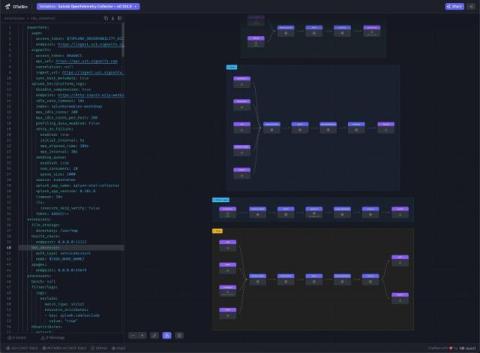
An Overview of the OpenTelemetry Collector's Configuration File

In this video, I’ll provide an overview of the OpenTelemetry Collector’s configuration file (config.yaml) with examples from the Splunk distribution. I will briefly explain the components of the Splunk OTel Collector, and walk you through a sample generic configuration of the OTel Collector. We’ll then use the Splunk Observability Cloud interface to construct the commands needed to install the Splunk OTel Collector on a specific host. This installation will copy a default Splunk OTel Collector configuration onto the host, and we’ll review the Splunk specific components of this configuration.

Setting up and Understanding OpenTelemetry Collector Pipelines Through Visualization

Observability provides many business benefits, but comes with costs as well. Once the (not-insignificant) work of picking a platform, taking an inventory of your applications and infrastructure, and getting buyin from leadership (both from the business and engineering sides of the house) is done, you then have to actually instrument your applications to emit data, and build the data pipeline that sends that data to your observability system.