Operations | Monitoring | ITSM | DevOps | Cloud

How to normalize data for incident management

Handling IT alert data can feel like you’re drowning in information. The average BigPanda customer uses more than 20 observability and monitoring tools. Between system logs and user reports, an overwhelming amount of information is coming from all directions. That’s why normalizing data is such a critical part of IT operations. Data normalization in IT incident management involves putting data from various tools into a standard format.
Incident response plans: Benefits and best practices

The primary objective of an IT incident response plan is to clarify roles and responsibilities, communication protocols, escalation scenarios, and technical steps to minimize further damage and safeguard business operations. The plan formally defines guidelines, procedures, and activities for identifying, evaluating, containing, resolving, and preventing IT incidents. Whether they cause intermittent errors or global service crashes, IT incidents can severely disrupt service quality and cause outages.

Digital Workspace Sustainability: Tracking Carbon and Energy Consumption for IT Sustainability Goals

As the world moves towards sustainability, IT operations and digital workspaces are becoming critical in achieving corporate sustainability goals. The digital transformation of businesses—especially in light of hybrid and remote working models—has increased the demand for IT infrastructure, which in turn raises concerns about energy consumption, carbon emissions, and environmental impact.

Reduce alert noise and resolve incidents faster with ignio Event and Incident Management

Eliminate noise, gain actionable insights, and remediate issues before they impact your business Are you struggling with huge volumes of events and alert noise in your IT Operations? Most enterprises today face challenges in maintaining operational IT resilience and ensuring continuous service availability due to the sheer volume of IT events coming for different monitoring and observability tools.

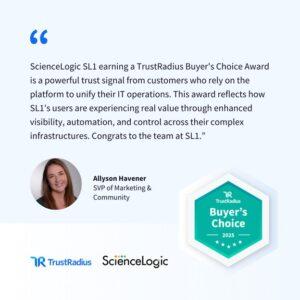
ScienceLogic Wins TrustRadius's 2025 Buyer's Choice Award

At ScienceLogic, we’re dedicated to leveraging innovation to enhance customer satisfaction. Our mission is to transform the complexity of IT operations into a streamlined and straightforward workflow, empowering our customers to focus on what matters most. We’re thrilled to see this commitment recognized with the 2025 TrustRadius “Buyer’s Choice” Award (formerly the “Best of” Awards), a distinction we previously received in 2022 and 2023.

Unveiling Innovation - Digitate's Flamingo Release

Join Rahul Kelkar, Chief Product Officer, and Avi Bhagtani, Chief Marketing Officer of Digitate, as they unveil Digitate’s latest ignio Flamingo release. This significant advancement underscores our commitment to empowering autonomous enterprises through enhanced capabilities, closed-loop automation, and AI-driven solutions. In this video, discover how our cutting-edge generative AI features address real IT challenges by enabling proactive problem-solving, automating responses to recurring issues, and generating intelligent insights for informed decision-making.

Five core incident response phases for ITOps

Effective IT event management is about more than restoring services. Managing and mitigating threats involves a comprehensive approach with five incident response phases: It’s crucial to take a structured approach to addressing disruptive events. Incident response involves multiple phases to minimize the impact and prevent service outages. An “incident” is any event that disrupts normal operations or threatens your information systems.

Comprehensive Observability: Key User Experience Metrics to Monitor in Cloud Environments

As we conclude our three-part series on key observability metrics ScienceLogic monitors, this blog focuses on the analysis and impact of user experience (UX) metrics to shed light on their business impact. Whether it’s an internal business application or a customer-facing platform, a seamless and efficient user experience can significantly impact satisfaction, productivity, and loyalty.

How observability, AI and automation is leading the workload management evolution

Workload management is ubiquitous when it comes to automating critical business processes. With time, workload management as a technology is going through a gradual evolution, from ‘just automation’ to an orchestrator of intelligent automation. This necessitates a layer of observability and intelligence to facilitate the move from workload automation to workload management.

CloudFabrix Unveils Cutting-Edge Innovations at GenAI Summit 2024

At the GenAI Summit in San Francisco, from May 28th to 31st, CloudFabrix proudly showcased the latest advancements of its Macaw GenAI Assistant and its Robotic Data Automation Fabric (RDAF) platform. These technologies are not only reshaping the future of IT operations and observability but also setting the stage for the company’s next chapter as a member of the NVIDIA Inception Program.

What is a runbook for IT operations?

A runbook is a structured document detailing standardized procedures for completing routine IT operations processes. Runbooks are comprehensive guides that outline the steps and dependencies required to manage infrastructure, applications, and services within your IT operations. Runbooks bring order and organization to ITOps. These guides offer simple instructions for your team to handle challenges confidently and efficiently.

Crawl, Walk, Run: Implementing AI and Generative AI on Your Journey to Autonomic IT

As IT environments continue to expand in scope and complexity, understanding their impact on organizations is more important than ever. That’s why ScienceLogic commissioned research specialist Vanson Bourne to survey 400 IT operations professionals across the USA, UK, Germany, and Canada with the goal of understanding the challenges they’re facing and the technologies—including automation, AI, and generative AI—they’re using to overcome them.
Sponsored Post

Telemetry Pipelines: Elevate Your Data Workflow with CloudFabrix

In an era where digital infrastructures are increasingly hybrid, the ability to efficiently monitor, analyze, and act on vast amounts of operational data is a significant challenge. According to Gartner, the surge in data volumes, with some workloads producing petabytes of telemetry annually, has led to heightened complexity and soaring costs—potentially exceeding $10 million annually for large enterprises.

AIOps monitoring: Definition, uses, and features

AIOps monitoring is a proactive process that uses AI to anticipate and identify IT infrastructure issues. Going beyond traditional troubleshooting, it enables your systems to detect anomalies in advance to prevent potential disruptions. AIOps uses advanced technology like AI and machine learning to simplify IT operations. AIOps monitoring collects and analyzes large data sets from diverse sources, such as logs, metrics, and events.

Digitate's Flamingo release advances AI and unified observability to power the autonomous enterprise

Digitate announces the general availability of ignio™ Flamingo, featuring a robust suite of AI-driven capabilities across its award-winning products and solutions to further the vision of an autonomous enterprise.

4 elements of AI copilots for incident management

Generative AI has immense potential to transform how IT operations, service management, and infrastructure teams function. However, integrating GenAI technologies, like copilots, often brings significant challenges, such as ensuring accuracy, addressing job displacement concerns, and demonstrating tangible value. Navigating the landscape of various vendors and implementation hurdles can be time-consuming and resource-intensive.

Transform ITOps and incident management with AI copilots

There are many ways to apply generative AI to modernize IT operations. Advances in GenAI have paved the way for the development of AI-powered ITOps copilots, which have the potential to transform IT operations. AI copilots offer many benefits for IT, including improved decision-making, accelerated incident management timelines, and optimized workflows.

Comprehensive Observability: Key Performance Metrics to Monitor in Cloud Environments

Enterprises need strong observability to ensure system reliability, proactively detect and resolve issues, optimize performance, enhance security, and maintain seamless business operations across complex distributed environments.

The Future of Data Compliance in the Public Sector: Trends and Predictions

As organizations in the public sector continue to undergo what Deloitte has called a “radical transformation” and embrace new, innovative technologies, they’re seeing improvements in everything from agility to customer experience. And, the good news is that innovation tends to breed more innovation, meaning the digital transformation of the last two decades laid the groundwork for the widespread use of artificial intelligence (AI).

Four ways observability can enhance IT resilience in 2025

Enterprises are yet to hit a sweet spot with their IT infrastructure monitoring. Despite investing thousands of dollars and getting a bunch of monitoring tools, it is almost always true that the customer catches the issue before the monitoring tool does. In today’s time, teams are looking at more than just monitoring tools. In fact, they want a system that can detect and resolve the issue in the same platform without any delays or intervention.

Driving Unparalleled Growth for MSPs and Deliver Value for Their Clients with ScienceLogic

Since ScienceLogic was founded in 2003, our goal has been to support our partners, including Managed Service Providers (MSPs), with solutions that help them and their clients gain unparalleled visibility into their IT environments. Our objective has always been to help these organizations bring order to complexity, turn inefficiencies into productivity, and, in the process, help service providers and the companies they serve exceed their business objectives.

Guide to incident response metrics and KPIs

IT incident management focuses on quickly identifying and resolving IT issues to restore normal service operations. Tracking key performance indicators (KPIs) of incident response is vital in minimizing service disruptions affecting customers and users. With so much data and many things to track, it’s difficult to identify which metrics and KPIs are right to track. What are the right incident response metrics to use to drive meaningful improvements?

Capturing a Complete Topology for AIOps

Our thinking and use of topology within AIOps and Observability solutions from Broadcom has advanced significantly in recent years while solidly building on our innovative domain tools. We’re looking to communicate these innovations, advancements, and benefits for IT operations. In this blog, we continue where the previous blog left off to explain the boundary blame concept and mechanism to obtain a sufficiently complete topology.

Comprehensive Observability: Key Availability and Reliability Metrics to Monitor in Cloud Environments

Strong observability in cloud environments is essential for monitoring the health of interconnected systems. Unlike traditional monitoring, which is limited to specific cloud stacks or devices, observability provides comprehensive visibility across the entire hybrid IT infrastructure including applications, IT systems and services.

The need to accelerate innovation in IT operations

First, let me give you proof that AI didn’t write this. The discerning human is learning that a significant portion of the media they consume is AI-generated or at least AI-enhanced. AI readers will likely crawl this post and distribute it to those the algorithm deems to be likely prospects for our product.

Gain the benefits of adopting an AIOps strategy

Managing IT operations is becoming more complex with the rapid evolution of IT environments. As a result, leaders are looking for more efficient, intelligent ways to monitor and maintain their IT systems. AIOps has evolved as one of the most promising solutions in recent years. AIOps uses machine learning (ML), big data, and automation to streamline IT operations.

The Journey to Autonomic IT: Progressing to AI-Advised IT

So far, we’ve detailed the Autonomic IT maturity model and discussed the characteristics of the early stages of that journey, progressing from “Siloed IT” to “Coordinated IT” and then to “Machine-Assisted IT in recent blog posts.” Wherever your organization is on this journey, there is likely still work to be done.

The Journey to Autonomic IT: Progressing to Machine-Assisted IT

So far, we’ve detailed the Autonomic IT maturity model and discussed the characteristics of the early stages of that journey, progressing from “Siloed IT” to “Coordinated IT” and then to “Machine-Assisted IT in recent blog posts.” Wherever your organization is on this journey, there is likely still work to be done.

Unified observability Maximize visibility & control of multi cloud environments

In today’s multi-cloud world, gaining real-time visibility across complex infrastructure is vital for business resilience and IT efficiency. However, traditional observability tools often fall short, leaving gaps in data collection and actionable insights. This is where unified observability comes in. Unified observability is Digitate’s unique approach, enabling organizations to monitor and control their business, applications, and infrastructure layers from a single pane of glass.

A Maturity Model for Network AIOps

AIOps is ushering in a new era in which enterprise operations are fully autonomous under the supervision of operations staff. However, this shift requires an evolution of current practices and technologies. In this comprehensive guide, we present a four-stage model for embracing AIOps, going from the lowest level to the highest visionary state.