Operations | Monitoring | ITSM | DevOps | Cloud

The latest News and Information on Containers, Kubernetes, Docker and related technologies.

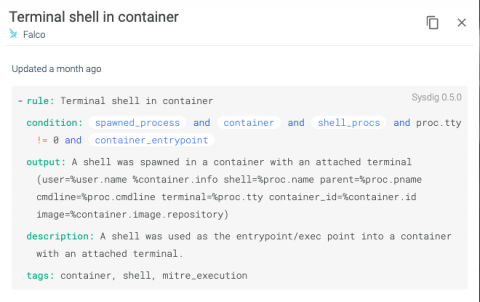
File Integrity Monitoring: Detecting suspicious file activity inside a container

In this blog, we will explore suspicious file activity inside a container and see how to effectively implement a file integrity monitoring (FIM) workflow. We’ll also cover how Sysdig Secure can help you implement FIM for both containers and Linux hosts.

The Fastest at the Edge

When you think of Kubernetes, you probably don't think "fast," but that's what K3s has at its core. Designed for resource-constrained environments like IoT and the Edge, K3s is lightning fast, robust, and powerful, and it includes innovative new features like its Helm controller. In this short video, Adrian Goins talks about K3s, MetalLB, Nginx, Traefik, and Helm while doing an install of a K3s system with MetalLB, Nginx, and Mosquitto in only a few minutes.

What Are the Hardest Parts of Kubernetes to Learn?

Many enterprises have already adopted Kubernetes or have a Kubernetes migration plan in place, making it clear that the platform is here to stay. While it provides a lot of benefits to its users, to take advantage of them, you need to thoroughly learn Kubernetes and how it works in production. Typically, the most difficult aspects of Kubernetes are learned through experience solving real-world problems.

We've Raised $27 Million in New Funding, Here's How We're Investing It

Today we’re announcing a new round of funding that brings an additional $27M to help us invest in growing and building Codefresh. When we started, we wanted to revolutionize the way people build and deploy software with continuous integration and delivery. I’m proud to say that we were the first platform to see the game-changing value of containers and Kubernetes.

Autoscaling an Amazon Elastic Kubernetes Service cluster

In this article we are going to consider the two most common methods for Autoscaling in EKS cluster: The Horizontal Pod Autoscaler or HPA is a Kubernetes component that automatically scales your service based on metrics such as CPU utilization or others, as defined through the Kubernetes metric server. The HPA scales the pods in either a deployment or replica set, and is implemented as a Kubernetes API resource and a controller.

Logging for Kubernetes: fluentd and ElasticSearch

This article will focus on using fluentd and ElasticSearch (ES) to log for Kubernetes (k8s). This article contains useful information about microservices architecture, containers, and logging. Additionally, we have shared code and concise explanations on how to implement it, so that you can use it when you start logging in your own apps. ‍Useful Terminology.

Driving Service Reliability Through Autoscaling Workloads on OpenShift

In this webinar, Ara Pulido, Technical Evangelist at Datadog, will demonstrate how to autoscale your application workloads on OpenShift. You will learn frameworks for how to identify their key work and resource metrics; as well as how to use them to drive horizontal and vertical pod autoscaling so that you can maximize efficiency, while ensuring service reliability.

Civo Community Meetup #1 w/ Saiyam Pathak and Alistair Hey

The very first Civo Community Meetup is here! Episode #1 featured talks from Civo CTO Andy Jeffries and Developer Advocate Kai Hoffman, alongside #KUBE100 community members Saiyam Pathak and Alistair Hey. This meetup not only focussed on the direction of Civo and what's in store for the future for us, but also shared insights into the Civo marketplace and Terraform provider, plus k3s development using OpenFaaS with Civo k3s.