Operations | Monitoring | ITSM | DevOps | Cloud

The latest News and Information on Cloud monitoring, security and related technologies.

Microsoft Fabric Explained: All you need to know

What is Microsoft Fabric? Microsoft Fabric is an end-to-end analytics solution with full-service capabilities including data movement, data lakes, data engineering, data integration, data science, real-time analytics, and business intelligence—all backed by a shared platform providing robust data security, governance, and compliance.

Navigating Multi-Cloud Environments: Managing Deployments with Ease

Multi-cloud seems like an obvious path for most organizations, but what isn’t obvious is how to implement it, especially with a DevOps centric approach. For Cycle users, multi-cloud is just something they do. It’s a native part of the platform and a standardized experience that has led to 70+% of our users consuming infrastructure from more than 1 provider.

The importance of Azure cost to DevOps

Cloud computing’s ascent has redefined modern business operations. Azure, among other platforms, offers unparalleled scalability, speed, and resilience. However, this vast potential brings about the challenge of cost management. Although DevOps teams traditionally focus more on deployment and uptime, addressing Azure costs is essential. Here’s why.

How to get your security team on board with your cloud migration

To find out more about cloud migrations, the pitfalls that await the unwary, and what the security implications are, I recently sat down with Dustin Dorsey, Systems & Data Architect at Biobot Analytics, based in Cambridge, MA. In the first post in this series, we talked about cloud providers being responsible for security ‘of’ the cloud, while their clients are responsible for security ‘in’ the cloud.

Test Automation - A Key to Telco Cloud Adoption

While industry experts struggle to find consensus on the path to Telco Cloud, almost everyone agrees that automation will play an outsized role in helping network operators overcome the challenges they face in adopting and successfully deploying Telco Cloud. For many network operators, the very inefficient pace of their existing software upgrades is a key challenge they must address to migrate their network to a modern Telco Cloud.

Monitoring Amazon SageMaker with Datadog

Amazon SageMaker is a fully managed service that enables data scientists and engineers to easily build, train, and deploy machine learning (ML) models. Whether you are integrating a personalized recommendation system into your video streaming application, creating a customer service chatbot, or building a predictive business analytics model, Amazon SageMaker’s robust feature set can simplify your ML workflows.

Defining Your Cloud Core Migration Strategy - Fail to Prepare, Prepare to Fail

In this enlightening panel discussion from the Telco Core Strategy Summit, industry experts discuss the intricacies of cloud core migration. Learn from seasoned professionals, including Kentik’s Justin Ryburn, as they share insights on cloud migration challenges, the importance of automation, and strategies to maintain security and performance. Understand the significance of detailed planning, the shifting dynamics of workloads in the cloud, and how to navigate the complexities of this transformative journey.

Security in the cloud: Whose responsibility is it?

While the cloud is recognized as more secure than on-premises servers and infrastructures, it does come with the often talked about shared responsibility model. Cloud providers are responsible for security ‘of’ the cloud, while their clients are responsible for security ‘in’ the cloud. It’s ‘differently secure’, rather than the traditionally secure organizations have been used to when working with on-premises environments.

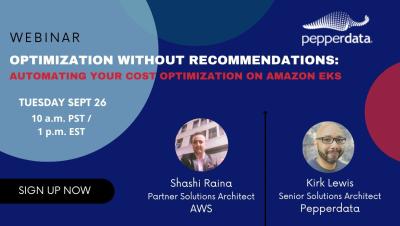
Optimization Without Recommendations: Automating Your Cost Optimization on Amazon EKS

Learn how Pepperdata uses machine learning to provide Continuous Intelligent Tuning automatically to your Amazon EKS applications, helping your platform team recover wasted capacity and ultimately reduce your spend for cloud resources.