


Operations | Monitoring | ITSM | DevOps | Cloud

How Data Centre Energy Consumption Impacts Business Efficiency and ESG Goals

Data centre energy use has become a critical factor in business infrastructure strategy. Once a background cost, it now plays a direct role in decisions about operational resilience, sustainability reporting, and future capacity planning. The scale of consumption is hard to ignore. Even smaller facilities can draw between 1 and 5 MW of continuous power, enough to supply thousands of homes. Larger hyperscale environments consume significantly more, 20 MW to over 100 MW of power.
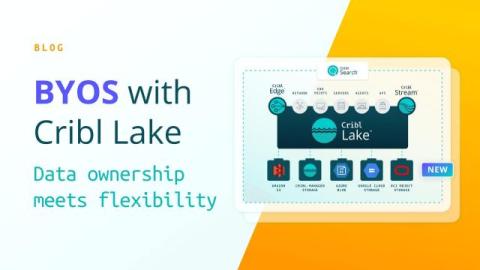
BYOS with Cribl Lake: Data ownership meets flexibility

Today, more than ever, organizations face a difficult balancing act: how to keep sensitive data fully under their control while still making it accessible and usable so teams can unlock the value and insights they need. Industries such as financial services, healthcare, and government agencies often must comply with strict regulations that require data to remain in environments they directly own and manage.

Cribl.Cloud Goes to Washington: Cribl.Cloud Government FedRAMP Authority to Operate Milestone

Way back in 2009, when I was serving as a second lieutenant in the U.S. Army, I worked in a network operations center for a deployed Army unit. Our mission was to provide network connectivity across central and northern Iraq. Our observability tools were incredibly limited. We had a network map that would turn nodes and network links red, yellow, and green when they were up or down. We had to write down in a physical logbook any status changes and what we did about them.

Cribl.Cloud Government Is a New Era of Secure Cloud Telemetry for Federal Agencies

As a Co-founder and CPO at Cribl, I'm genuinely stoked that our new federal suite, Cribl.Cloud Government, has achieved an “In Process” designation under the Federal Risk and Authorization Management Program (FedRAMP). This isn’t any old milestone. We’re bringing all of Cribl’s kickass capabilities to government agencies, even those that require the strictest compliance and security standards. Because, who doesn’t love a good set of rules?

Icinga Experience: Insights from Real-World Icinga Deployments Across Industries

Modern IT environments are hybrid, distributed, and constantly growing. To keep them reliable, organizations rely on monitoring that scales, automates, and integrates seamlessly into existing workflows. We collected 24 Icinga customer stories from industries including finance, telecom, manufacturing, and public services. What unites them is the choice of Icinga as a flexible and cost-efficient alternative to proprietary monitoring tools.

The Future of IT Operations - Why AIOps Is Perfect for Fast Growing Businesses

The future of IT operations is here, and that’s why AIOps is perfect for fast growing businesses. It is 2025 and companies need to scale quickly without sacrificing performance, stability, or customer experience. AIOps (Artificial Intelligence for IT Operations) provides the perfect solution by combining automation, machine learning, and advanced analytics to manage complex IT environments with ease.

COREDUMP #016: From Startup to Global Brand: Scaling Engineering at reMarkable

In today’s Coredump Session, we sit down with Nico Comier, CTO of reMarkable, to explore the journey from early-stage startup to global brand. Nico shares insights on scaling engineering teams, balancing technical credibility with leadership responsibilities, and what it really takes to bring a hardware product to market. From the pressures of product launches to the importance of customer connection, this conversation dives into the realities of building impactful technology.

AI's Impact on Software Devs Productivity & Downsides

AI is boosting flow, job satisfaction, and productivity for devs. But here’s the twist: it’s not actually giving us more time to do valuable work. In his GitKon talk, Nathen Harvey digs into the real impacts of AI adoption in technical teams. Yes, AI reduces toil and improves satisfaction. But it also shifts how we spend our time and sometimes that means less “valuable work” gets done. So the question becomes: how can we use AI not just to work faster, but to work better?