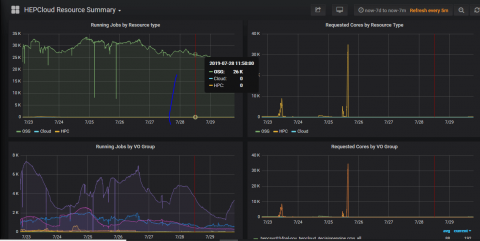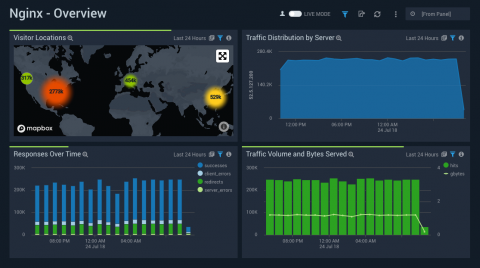
A couple months ago, we wrote about some Grafana dashboards that large organizations, for a variety of reasons, have made public with their actual live data. And we followed that up with a look inside the public dashboards at GitLab, a self-described “ridiculously transparent” company. It’s always interesting to see how Grafana users are setting up their visualizations, so we decided to do another roundup. Check these dashboards out, and get inspired.
The holy grail for any CMO looking for their next gig is to find the perfect combination of addressable market, market timing, company, and product. That’s why I am so excited to be joining the team at Rancher Labs, the leader in container management software. Let’s look at all the variables.
We are happy to announce a new release for Icinga Web 2, version 2.7.0. Official packages are available on packages.icinga.com. You can find all issues related to this release on our Roadmap.
Many articles have been written about AWS Step Functions since it was first introduced in 2016. Most of them create the impression that the service is simply an extension of the Lambda function that allows us to stitch together multiple Lambda functions to call each other. But actually, it is much more than that. Step Functions allows us to design and build the flow of execution of modules in our application in a simplified manner.
With serverless computing, our daily tasks and routines are much more comfortable than they used to be before. Serverless allows us to put our focus on the code itself without the need to worry about the configuration of the underlying compute resources or maintenance. Numerous cloud providers (AWS included) gives us a variety of previously managed services which we can combine and create a massively scalable and incredibly robust serverless microservices.
If you’re just joining us, I highly advise you to go back and check out our first two parts of this three part series regarding NGINX and Sumo Logic where we go over a basic Introduction to NGNIX and also Touch Up On NGINX, Logs, and Why Logs Are Important. If you’ve been following along, then great, let’s jump right into it.
This is a guest post by Noah Zoschke, Engineering Manager at Segment. Segment is the customer data infrastructure that makes it easy for companies to clean, collect, and control their first-party customer data. At Segment, our ultimate goal is to collect data from Sources (e.g., a website or mobile app) and route it to one or more Destinations (e.g., Google Analytics and AWS Redshift) as quickly and reliably as possible.