Operations | Monitoring | ITSM | DevOps | Cloud

StackStorm joins the Linux Foundation

StackStorm is headed for the Linux Foundation! This is a big move and we're excited to share this news with our community. For several months now we've been working with the Linux Foundation, the StackStorm team, and many others inside Extreme to make this move possible. We want to thank everyone for their effort to make this move happen. StackStorm's community continues to grow and the impact the project has had continues to show, and show, and show, and show (you get the point).


Vodafone Utilizes PagerDuty to Better Understand Their Real-Time Operations

Vodafone is a telecommunications company providing 4G network coverage for 18 million customers and 99% of the United Kingdom’s population. Ben Connolly, Head of Digital Engineering at Vodafone, details the challenges that his engineering teams were facing and why PagerDuty was the perfect fix. PagerDuty helps Vodafone deliver a better customer experience by allowing their teams to see the impact that they're having in real time.

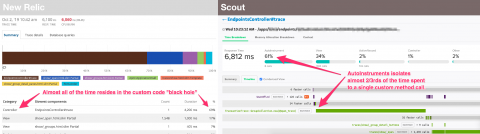
Introducing AutoInstruments: zero-effort performance monitoring of custom Ruby code

Instrumenting the performance of custom code (the code you write, not the libraries you require) in web apps has been a thorn in my side for years. Yes, we have a custom instrumentation API, but raise your hand if you enjoy sprinkling your code with this? Anyone? Having a custom code instrumentation blackhole doesn't matter if your app spends almost all of its time in common libraries that Scout instruments by default (ex: ActiveRecord, Redis, View Rendering, and HTTP calls).

Introducing the lumigo-cli

Here at Lumigo, we are big fans of serverless. And a big part of working with AWS Lambda involves using many other AWS services. For example, services such as SNS and SQS are often used to chain Lambda functions together. They are essential ingredients of an event-driven architecture, where systems are loosely coupled through events. However, they also pose a challenge to how we test our systems and how to get fast feedback on what’s happening in the system.

Don't Treat Your Business Metrics Like Other Metrics

Many companies today try to feed business metrics into APM or IT monitoring systems. Splunk, Datadog and others track your business in real time, based on log or application data – something that would seem to make sense. In practice, however, it fails to produce accurate and effective monitoring or reduce time to detection of revenue-impactful issues. Why? Because monitoring machines and monitoring business KPIs are completely different tasks.

IBM Log Analysis with LogDNA

IBM Cloud Log Analysis with LogDNA enables you to quickly find the source of issues and gain deeper insight into application and cloud environment data. IBM Cloud logging begins with log aggregation from application and services within IBM Cloud. IBM partners with LogDNA to bring collection, log tailing and blazing fast log search. LogDNA supports integrations to many cloud-native runtimes and environments.

Paul Dix [InfluxData] | Where Flux and InfluxDB Are Headed | InfluxDays SF 2019

Paul will talk about the long-term vision for Flux the language as well as InfluxDB 2.0, Telegraf 2.0 and beyond. He’ll talk about why we’ve decided to create a language, how that plays into polyglot persistence & purpose-built time series databases, and how it enables more complex analytics and processing workloads to drive insights from data not just in InfluxDB, but everywhere.

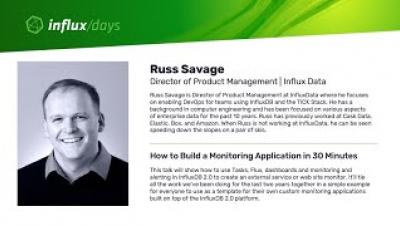
Russ Savage[InfluxData] | How to Build a Monitoring Application in 30 Minutes | InfluxDays SF 2019

This talk will show how to use Tasks, Flux, dashboards and monitoring and alerting in InfluxDB 2.0 to create an external service or website monitor. It’ll tie all the work we’ve been doing for the last two years together in a simple example for everyone to use as a template for their own custom monitoring applications built on top of the InfluxDB 2.0 platform.

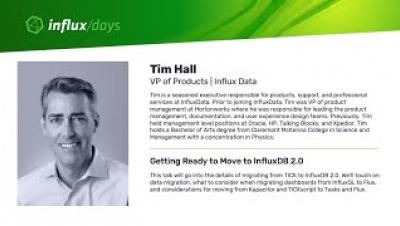
Tim Hall [InfluxData] | Getting Ready to Move to InfluxDB 2.0 | InfluxDays 2019

This talk will go into the details of migrating from TICK to InfluxDB 2.0. We’ll touch on data migration, what to consider when migrating dashboards from InfluxQL to Flux, and considerations for moving from Kapacitor and TICKscript to Tasks and Flux.