Operations | Monitoring | ITSM | DevOps | Cloud

The latest News and Information on Observabilty for complex systems and related technologies.

Refine Your Observability Experience at Scale

Today, we announced that Refinery is now generally available. With Refinery, it’s now easy to highlight the critical debugging data you need and to stop paying for the rest. Refinery is a sampling solution that lets you control resource costs at scale without sacrificing data fidelity. Support for Refinery is now also included in Honeycomb Enterprise plans.

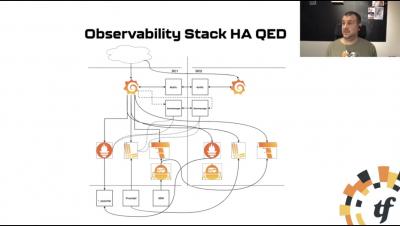
Azure Management Talk: Application Observability in a Distributed world

In this session, Chris Reddington will provide an overview of Application Insights and how it slots into the wider Azure Monitoring ecosystem. We will explore Alerts, Metrics, Queries, Dashboards, Workbooks and more, and how Application Insights can bring clarity to a distributed cloud deployment.

Sweetening Your Honey

Are you looking for a better way to troubleshoot, debug, and really see and understand what weird behavior is happening in production? Service-level objectives (SLOs) and observability can help you do all that—but they require collecting and storing the right data. If we’re naive with our telemetry strategy, we spend a lot of money on storing data without seeing adequate return on investment in the form of insights.

Observability is transforming ITOM landscape as next generation monitoring

First things first. Observability is inherent as a principle to a system and not something that is instilled. Here, we are addressing observability as an open source based solution in the context of insightful monitoring within the ITOM landscape. ITOM is now in the middle of addressing the needs of the expanding and dynamic nature of IT infrastructure as a function. It is no longer about being a monolithic computing stack. It is now beyond monitoring discrete infrastructure elements.

Key Differences Between Observability and Monitoring - And Why You Need Both

Observability and Monitoring are viewed by many as interchangeable terms. This is not the case. While they are interlinked, they are not interchangeable. There are actually very clear and defined differences between them. Monitoring is asking your system questions about its current state. Usually these are performance related, and there are many open source monitoring tools available. Many of those available are also specialized.

How to monitor NVIDIA GPU metrics with Elastic Observability

Graphical processing units, or GPUs, aren’t just for PC gaming. Today, GPUs are used to train neural networks, simulate computational fluid dynamics, mine Bitcoin, and process workloads in data centers. And they are at the heart of most high-performance computing systems, making the monitoring of GPU performance in today's data centers just as important as monitoring CPU performance.

Surveying the Tides of Cloud-Native & Open Source Observability

We can plausibly say the enterprise development market turned the tide on cloud-native development in 2020, as most net-new software and serious overhaul projects started moving toward microservices architectures, with Kubernetes as the preferred platform.

Getting Started with Java & OpenTelemetry

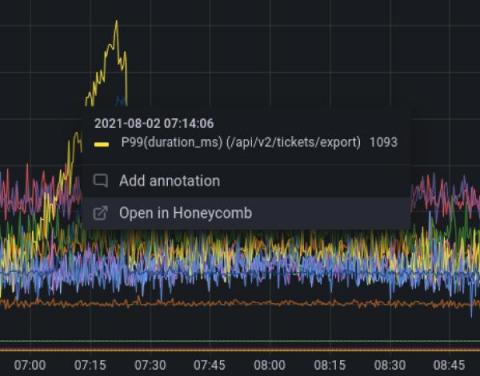
It’s easy to get started with Java and Honeycomb using OpenTelemetry. With Honeycomb being a big supporter of the OpenTelemetry initiative, all it takes is a few parameters to get your data in. In this post, I will walk through setting up a demo app with the OpenTelemetry Java agent and show how I was able to get rich details with little work by combining automatic instrumentation from the agent with custom instrumentation in the code.

Introducing Grafana Enterprise Logs, a core part of the Grafana Enterprise Stack integrated observability solution

Today, we are launching a new Grafana Labs product, Grafana Enterprise Logs. Powered by the Grafana Loki open source project for cloud native log aggregation, and built by the maintainers of the project, this offering is an exciting addition to our growing self-managed observability stack tailored for enterprises.

How to monitor Amazon ECS with Elastic Observability

With an increasing number of organizations migrating their applications and workloads to containers, the ability to monitor and track container health and usage is more critical than ever. Many teams are already using the Metricbeat docker module to collect Docker container monitoring data so it can be stored and analyzed in Elasticsearch for further analysis. But what happens when users are using Amazon Elastic Container Service (Amazon ECS)? Can Metricbeat still be used to monitor Amazon ECS? Yes!