Operations | Monitoring | ITSM | DevOps | Cloud

Cloud Outage Response: Lessons From July's Bad Week

In a single week, two of the largest cloud providers on earth failed at almost the same time, and a good chunk of the internet went with them. Effective cloud outage response stopped being a theoretical exercise and became the difference between a calm 30 minutes and a chaotic afternoon for thousands of on-call engineers. On July 23, 2026, a maintenance bug inside Microsoft Azure pulled IP routes off more devices than intended in the West US region, cutting Microsoft 365 access for millions.
Sponsored Post

How Collective IQ Turns Reactive IT into Truly Proactive IT

Most IT organizations still operate in "firefighting" mode: an employee opens a ticket, the service desk investigates, depending on severity and complexity multiple teams or people are involved to diagnose, and then the appropriate person or team fixes the issue. The whole process then repeats for the next reported incident. This model doesn't scale, drains time and budget, and leaves a huge number of issues unresolved because many employees simply don't bother to report them. And, if and when they do report them, it's too late, the problem has already impacted their productive work.
Sponsored Post

No SAP Expertise? No Problem. Automation Just Got Easier

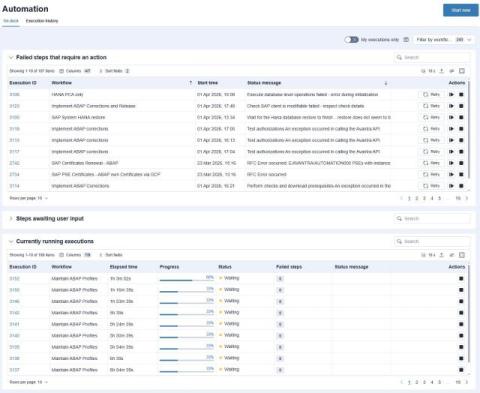
Avantra 21 introduced the concept of Automation workflows. By Avantra 23, compatibility with Ansible was added. Along the way, Avantra became the tool SAP teams reached for when they wanted system copies, refreshes, and backup orchestration to just run - predictably, on a schedule, without a senior engineer babysitting them. So, automation isn't new to Avantra users. Avantra made automation for SAP practical to deploy, predictable in operation, and easier to maintain.

AI fatigue: what happens when product teams can't keep up with their own agents

For the past two years, the conversation around AI in software engineering has focused on one thing: productivity. Engineers are shipping faster, writing more code, and completing work in hours that once took days. Every new model promises another leap forward. What gets far less attention is what all that speed demands from the people using it. Guillaume Moigneu, Field CTO at Upsun, has spent the past year watching engineering teams adapt to AI-assisted development.

Business continuity starts with portability

Business continuity planning has a quiet assumption built into most of it: that the infrastructure the plan runs on will cooperate. Backup systems will be accessible. Recovery procedures will work as documented. The provider whose services underpin the critical path will be available, or at least recoverable within the window the plan specifies. That assumption is tested every time a major provider has an outage, a regional failure, or a service disruption that cascades across dependent workloads.

Executive Roundtable: Guardrails for the Autonomous Era: Shipping Fast Without Breaking Things

Ask ten engineering leaders how far their organization has actually gotten with autonomous AI, and most will admit the same thing once the marketing language drops away: not nearly as far as it looks from the outside. That was the undercurrent of a roundtable Logz.io and Twingate hosted on July 22, 2026, bringing together VPs of engineering, CTOs, senior security directors, and several product leaders across different industries and company stages.

Shipped: Every cost recommendation now comes with the why and the how

A savings number tells you money is on the table, but it doesn’t tell you whether the finding holds up, what it’s based on, or what to do next. In that gap, recommendations pile up unactioned. When you’re staring at thousands of them, a title and a dollar figure isn’t enough to decide which are safe to act on.

Claude Opus 5 pricing: same sticker, different bill

Claude Opus 5 launched July 24, 2026 at $5 per million input tokens and $25 per million output tokens, identical to Opus 4.8. It delivers near Claude Fable 5 performance at half Fable's price and is now the default model on Claude Max. New effort settings let teams trade capability for token savings, which means two teams on identical pricing can now run up very different bills. Finance teams, that last part is your problem. Anthropic has shipped a model that costs exactly what the old one cost.

OpenAI Codex pricing in 2026: plans, token costs, and usage limits

Codex pricing runs six tiers, from free to $200 a month, but the sticker price is not your real bill. OpenAI Codex pricing 2026 charges by the token, not the plan, a change that took effect in April. Plus is $20, Pro starts at $100, and everything past that depends on how many files you let the agent read. Most Codex pricing guides hand you a price list and call it done. That is like pricing a taxi ride by the door handle. The meter is what matters, and OpenAI put a real one on Codex this year.