Operations | Monitoring | ITSM | DevOps | Cloud

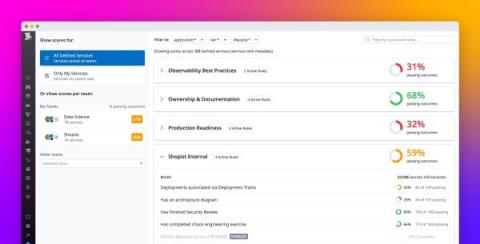
Formalize your organization's best practices with custom Scorecards in Datadog

The Datadog Service Catalog is a centralized hub of information around the performance, reliability, security, efficiency, and ownership of your distributed services. By using the Service Catalog, teams can eliminate knowledge silos and realize seamless DevSecOps workflows.


ITIM and the Public Sector: How Network Monitoring Rises to the Challenge

Government agencies and public sector organizations are a tantalizing hacker target. Cybercriminals go after public sector organizations because they hold confidential, often classified, information – the exact data state-sponsored and other criminal groups salivate over. The Cybersecurity and Infrastructure Security Agency, or CISA, along with the United States Computer Emergency Readiness Team, or CERT, have warned public sector IT of key threats.

ScienceLogic Secures the TrustRadius Best of Award in AIOps: A Triumph of Value, Features, and Relationships!

At ScienceLogic, we’ve always believed in the power of innovation and the importance of customer satisfaction. We are excited to announce that we have been honored with the TrustRadius Best of Award in the AIOps category for 2023. This is a testament to our dedication to providing exceptional value, top-notch features, and building enduring relationships with our customers.

Officially Worldwide: Cribl.Cloud and Cribl Search are now available in EMEA!

At Cribl, we give the people what they want. And what they want is to keep their data close to their sources and destinations. The less data has to travel, the better — lower latency and fewer security risks. This commitment to data locality is even more pronounced among our valued customers in the EMEA region, who are enthusiastically embracing cloud-first strategies.

Introducing Three Powerful Commands in Cribl Search: .show objects, .show queries, and .cancel

Empty spaces, what are we searching for? Abandon queries, but do you know the score? On and on, Does anybody know what we are looking for? … Inspired by “The Show Must Go On”, Queen. Since we launched Cribl Search back in late 2022, we’ve been hard at work on adding features and functionality that continue to empower data engineers to do more with their data without needing to collect it first.

How to Quickly Find What's Broken in Your Complex, Cloud Environment

With the rapid adoption of cloud, distributed systems and microservices are standard, resulting in increasingly complex environments. Once straightforward troubleshooting workflows have become chaotic, frustrating, and time-consuming. When something breaks, multiple teams are called to the table to prove they’re “not it”; each with their singular view of the problem.

Observability Shifts Right

Observability first emerged as a focal point of interest in the DevOps community in the 2017 time frame. Aware that business was demanding highly adaptable digital environments, DevOps professionals realised that high adaptability required a new approach to IT architecture. Whereas historically, digital stacks were monolithic or, at best, coarsely grained, the new stacks would have to be highly modular, dynamic, ephemeral at the component level, and spread over multiple cloud-based services.

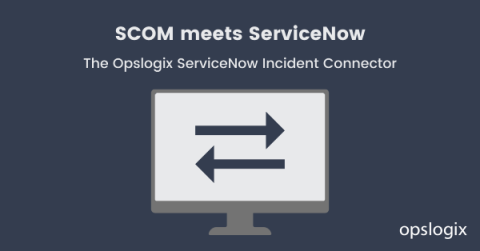
SCOM meets ServiceNow with the Opslogix ServiceNow Incident Connector

With the Opslogix ServiceNow Incident Connector for SCOM, you get a bi-directional data sync between SCOM Alerts and ServiceNow Incidents and Tickets Most organizations rely on a number of different tools to keep their operations running smoothly. Getting these tools to integrate seamlessly with each other is an essential factor in streamlining your operations, but sometimes, additional connectors might be needed in order to do so optimally.

Simplify OpenTelemetry Pipelines with Headers Setter

In telemetry jargon, a pipeline is a directed acyclic graph (DAG) of nodes that carry emitted signals from an application to a backend. In an OpenTelemetry Collector, a pipeline is a set of receivers that collect signals, runs them through processors, and then emits them through configured exporters. This blog post hopes to simplify both types of pipelines by using an OpenTelemetry extension called the Headers Setter.