Operations | Monitoring | ITSM | DevOps | Cloud

Getting started with Jaeger to build an Istio service mesh

Service mesh provides a dedicated network for service-to-service communication in a transparent way. Istio aims to help developers and operators address service mesh features such as dynamic service discovery, mutual transport layer security (TLS), circuit breakers, rate limiting, and tracing. Jaeger with Istio augments monitoring and tracing of cloud-native apps on a distributed networking system.


Fourteen Free SQL Software Tools

Our databases are the ones that keep the Internet alive. There has even been talk for some years about the development of operating systems with which users do not have direct contact with the files, but their personal files are stored in a local DB. In fact, we already see how there are online services that do this for us, such as Google Drive or Nextcloud, the latter written under free license Affero.

Notes from Observability Roundtables

The Velocity conference happened recently, and as part of it we (Honeycomb) hosted a sort of reverse-panel discussion, where you talked, and we listened. You may be aware that we’re in the process of developing a maturity model for the practice of observability–and we’re taking every opportunity we have to ask questions and get feedback from those of you who are somewhere along the path.

API Gateways are a thing of beauty. Here's why

AWS API Gateway is a completely managed service that makes developers’ job much easier by allowing them to publish, create, monitor, maintain, and secure APIs at any scale. In today’s article, we’ll talk more about API Gateway What is it, why is it so important, as well as how it can help us with?

How to monitor NGINX logs

In part one of our introduction to NGINX “What is NGINX” , we went over the basic history of NGINX, the difference between Apache and NGINX, and why you would use NGINX over Apache in certain environments and web applications. Today we’ll be diving deeper into NGINX and going over topics such as web server performance, monitoring said performance, how to obtain and archive logs for deeper analysis, and how to even tell which web server you’re running on your environment.

10 Lead Generation Tools for SaaS Companies

If you are a SaaS company and looking for different ways to generate high-quality leads but your sales team is absolutely clueless where to begin. Then you have stopped just at the right place. Whether you are looking for an email marketing solution, social media management, cold outreach or inbound content marketing – there is not one but many tools for each of your lead generation appetite. But to figure out which platform does what, it can be tricky for you.

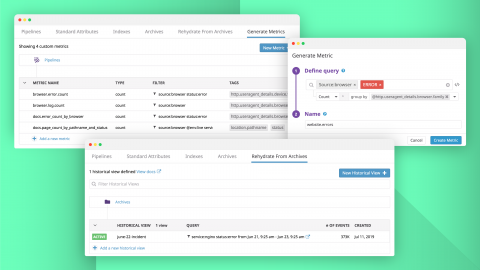
Introducing Metrics from Logs and Log Rehydration

As your application grows in size and complexity, it becomes increasingly difficult to manage the number of logs it generates and the cost of ingesting, processing, and analyzing them. Organizations often have little control over fluctuations in the volume of logs generated—and the resulting costs of collecting them—so they are forced to limit the number of logs generated by their applications, or to pre-filter logs before sending them to their log management platform.

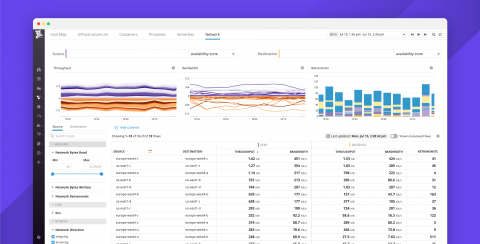
Introducing Datadog Network Performance Monitoring

Network Performance Monitoring is currently available in private beta. Request access here. Your applications and infrastructure components rely on one another in an increasingly complex fabric, regardless of whether you run a monolithic application or microservices, and whether you deploy to cloud infrastructure, private data centers, or both.

Dash 2019: Guide to Datadog's newest announcements

At Dash 2019, we are excited to share a number of new products and features on the Datadog platform. With the addition of Network Performance Monitoring, Real User Monitoring, support for collecting browser logs, and single-pane-of-glass visibility for serverless environments, Datadog now provides even broader coverage of the modern application stack, from frontend to backend.