Operations | Monitoring | ITSM | DevOps | Cloud

How Liftoff cut costs by 87% and latency by 75% with HAProxy

Liftoff, a mobile advertising company, processes 1.5 trillion bid requests every month. Their platform touches 275 million unique devices daily across 150 geographies. At that scale, the proxy layer is a core part of the business. For years, Liftoff relied on a managed enterprise proxy vendor. It worked, until it didn’t.

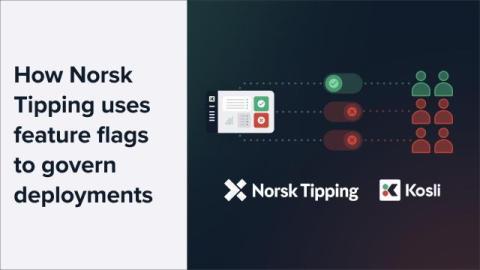
How Norsk Tipping uses feature flags to govern their deployments

Norsk Tipping is Norway’s state-owned gaming operator, running 2,500 to 3,000 production releases a year across iOS, Android, web and backend systems. Like every regulated organisation at scale, the platform team has to hold two things in tension: maintain strict deployment controls that stand up to audit, and keep the path to production open so that 100 engineers can ship safely.

How Clover moved beyond blue-green deployments with HAProxy Fusion Control Plane

Clover’s platform handles more than just payments: inventory, employee management, online sales, and customer loyalty programs are all running on a single monolith called the Clover Operating System (COS). Releasing updates to that platform reliably and without disrupting merchants is one of the hardest operational problems a platform team can face. For a decade, Clover ran HAProxy at the center of its infrastructure.

Minga cut infra costs 30-40% - and it scales itself | Control Plane

Minga checks in 1.5 million students across the eastern seaboard by 8:30 AM Eastern — then lets that infrastructure wind down an hour later. After migrating to Control Plane, they cut infrastructure costs 30–40% and traded fragile, manual scaling for a platform that scales itself.

How LivePerson optimized Logstash and Kafka performance on GCP through benchmarking

By benchmarking five GCP machine types across both Logstash and Kafka, LivePerson's observability team found that infrastructure selection (not just pipeline configuration) is one of the highest-leverage cost optimization decisions at scale.

How Airbnb Built a High-Volume Metrics Pipeline with OpenTelemetry and vmagent

We always knew that Airbnb’s engineering is operating on a completely different scale, and their new high-volume metrics pipeline is proof of that. This is one of those rare stories where scale and efficiency go hand in hand - they modernized their observability stack with open source components and reduced cost by an order of magnitude. Airbnb is now processing more than 100 million samples per second on a single production cluster.

How Criteo handles 23M requests per second (RPS) with HAProxy Runtime API automation

Criteo handles 23 million requests per second (RPS) while maintaining peak performance and minimizing downtime. For most organizations, handling that level of traffic is just a theoretical stress test — a what-if scenario should their infrastructure ever be overwhelmed by an unexpected wave of requests. But for Criteo, 23 million RPS is just another Tuesday.

How Kotak811 Revolutionized Digital Banking Observability with Coralogix

Kotak811, the digital-first engine of Kotak Mahindra Bank, is a banking platform serving over 23 million users across India. Since its launch in 2017, Kotak811 has transformed into the bank’s primary growth driver, now accounting for 70% of all new customer acquisitions. The platform is widely recognized for offering a paperless, mobile-first experience, providing everything from instant zero-balance accounts to seamless UPI payments and investment tools.

How PayPal hyperscaled Kubernetes routing with HAProxy Fusion

PayPal runs six data centers, each with around 60,000 containers. Their 30,000 employees spin up nearly 10,000 test environments every day — roughly 6 to 10 every minute. Each environment requires three config updates: one to create the virtual service, and additional calls to configure and deploy the applications. Do the math and you get a staggering 30,000 config updates per day.