Operations | Monitoring | ITSM | DevOps | Cloud

The latest News and Information on Monitoring for Websites, Applications, APIs, Infrastructure, and other technologies.

Icinga Director: Cloning dictionary row entries for objects from import sources

Over use of dictionaries in monitoring leads to complex and ugly configurations. This in turn makes monitoring complicated. Hence, it is advisable to use it, only if it is needed or in special cases. Even in these cases it is worthwhile to keep it simple. On that note, in this blogpost let me demonstrate how to clone dictionary row entries for objects from import sources to object properties in Icinga Director.

Visualize CockroachDB in Grafana: Introducing the CockroachDB Enterprise data source

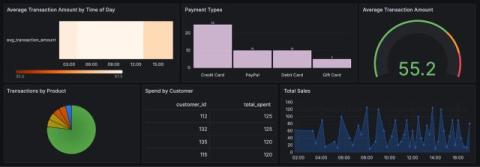
We’re excited to announce the addition of CockroachDB as an Enterprise data source for Grafana. The data source, available now in private preview, enables secure and seamless access to the CockroachDB distributed SQL database, while leveraging Grafana’s powerful visualization capabilities.

Three Advanced Notification Features that Your Site Uptime Monitoring Vendor MUST Deliver

To say that site uptime vendors deliver notifications is about as insightful as saying that cars have steering wheels, planes have wings, or TikTok videos have cringe. It’s a given. But this doesn’t mean that all vendors use the same notification playbook. Some vendors offer basic (read: superficial) notification features, while others offer advanced notification features.

PID Controllers and InfluxDB: Part 2 - Digital Twin

In a previous post, we described a CSTR and a PID controller. This post will cover the code and architecture of the digital twin from this project repo. The project leverages Kafka for data streaming, Faust for data processing, InfluxDB for storing the time series data, and Telegraf for writing data from the topic to InfluxDB. We’ll also cover the advantages and disadvantages of this stack.

Case Study: McKenzie Intelligence Services

McKenzie Intelligence Services (MIS) is a company specializing in damage assessment post-disasters. Their platform, the Global Events Observer (GEO), offers comprehensive coverage of natural and manmade disasters worldwide, such as hurricanes, floods, civil unrest, and rioting. MIS provides an expert-assessed view of the world through analysts who analyze various imagery sources, including satellite and street-level imagery.

Common Kafka Errors and How to Resolve Them

If you’ve ever worked with Apache Kafka, you know that it’s a powerful tool, but it can also be a bit finicky. Things can go wrong, and when they do, it’s important to know how to troubleshoot and resolve those issues quickly. Over the years, I’ve encountered my fair share of Kafka errors—some that had me scratching my head for days and others that were relatively straightforward once I knew what to look for.

SaaS Budget Planning Guide for IT Professionals

SaaS services are one of the biggest drivers of OpEx (operating expenses) for modern businesses. With Gartner projecting $247.2 billion in global SaaS spending this year, it’s no wonder SaaS budgets are a big deal in the world of finance and IT. Efficient SaaS utilization can significantly affect both the bottom line and employee productivity.

Elasticsearch vs MongoDB - Battle of Search and Store

Elasticsearch is primarily a search engine optimized for fast, complex search queries, especially text searches, and is often used for log and event data analysis. MongoDB, on the other hand, is a general-purpose, document-oriented database that excels in storing and retrieving structured and semi-structured data. It is commonly used for mobile, social, and IoT applications. While Elasticsearch provides superior search capabilities, MongoDB offers more robust data processing and storage features.